
A BUFFET OF STORIES … FAST! Port City Playwrights’ 'Ten-Minute Miscellany' returns to the Ruth and Bucky Stein Theatre

In a theater landscape increasingly dominated by scale, there is something quietly radical about restraint.
Not silence. Not minimalism for its own sake. But the disciplined spark of telling a complete story in the time it takes a kettle to boil.
I was first introduced to the Port City Playwrights’ through Jen Ingulli (who is directing two of this year’s 10-minute plays). The group started in 2016 as a small band playwrights to “read and critique each others’ work.” Their first run of “Miscellany” was during the pandemic, so masked audience members were floating in and out, and some scenes were read cold.
Since then, the show has progressed into a proper showcase of Wilmington’s writing talent.
This is the premise behind Port City Playwrights’ annual signature event, "Ten-Minute Miscellany," returning May 29–31, 2026 to the Ruth and Bucky Stein Theatre. Now in its sixth iteration, the evening has evolved into something closer to a micro-festival than a traditional production: ten plays, ten playwrights, and a rotating kaleidoscope of tone, genre, and theatrical imagination.
What emerges is not a single narrative, but a portrait of a city talking to itself—funny, fractured, earnest, and occasionally surreal.
A Homegrown Experiment That Stuck
Originally conceived as a way for local writers to hear their work aloud, "Ten-Minute Miscellany" has become, in the words of one longtime participant, “a buffet of creativity.”
The structure is simple: short plays, all written within the past year, cast and crewed entirely by local artists. But within that framework, the range is anything but restrained. The result is a theatrical sampler platter where dark drama sits beside absurd comedy, historical reflection brushes up against speculative futures, and emotional intimacy shares space with outright chaos.
It is also, crucially, a launchpad.
Some works begin here and expand elsewhere. Others exist only in this concentrated form—complete, contained, and intentionally fleeting.
Ten Worlds in One Evening
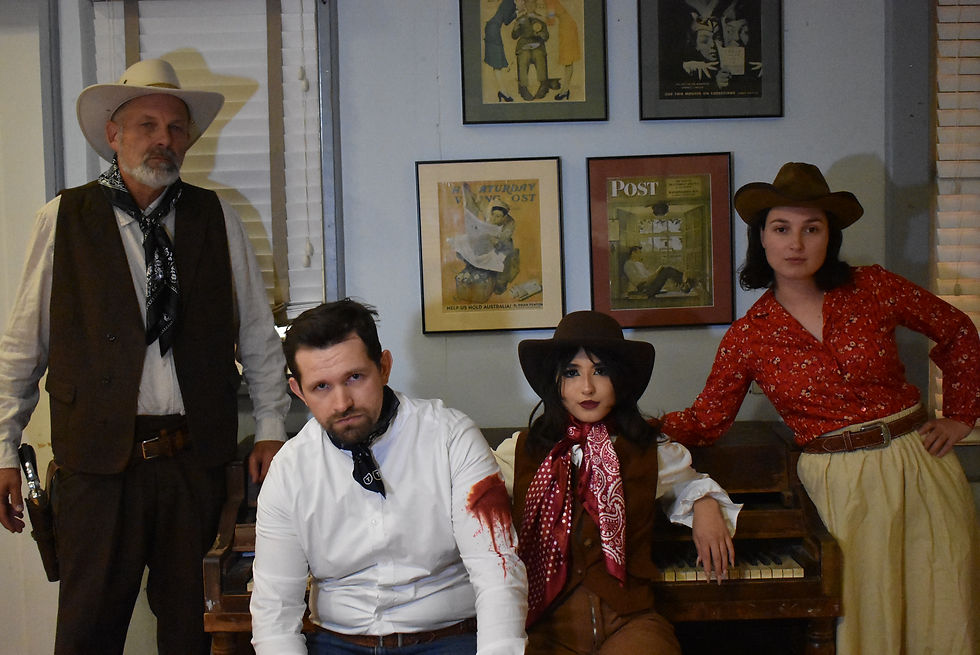
This year’s lineup leans into that sense of range and surprise. Audiences will move from a botched bank heist in "Duplicity" to a weather reporter accidentally revealing more than forecast data in "Good Morning Oregon." From there, the tone shifts again: a wounded angel discovered on rural farmland in "Fallen Angel," then into Victorian constraint and poetic longing in "If Thou Must Love Me," inspired by Elizabeth Barrett Browning.
Elsewhere, humor and unease share space in "Libraria," where an automated library assistant begins to glitch in ways both inconvenient and oddly human. In "Crazy or Not, Here I Come," an unlikely bond forms between an unhoused man and a volunteer, while "The Telescope Man" turns its gaze skyward, asking what it means to be seen—by teenagers, no less.
History also makes an appearance in "America's Ghosts: The Death of President Andrew Johnson," a meditation on national identity and unresolved political memory. And in "Super Egg," a teenager with a future alter ego navigates something far more universal than superpowers: adolescence.
The night closes—or perhaps bends—with "Our Two Angels," a roadside breakdown story that tests not just vehicles, but belief systems, as electric and hybrid worlds collide on a dark country road.
The People Inside the Plays
Behind the rapid-fire storytelling is a company built on connection and coincidence as much as craft.
One actor described stumbling into the production through a last-minute audition tip—arriving with a one-minute monologue and walking into what felt like improvisation on principle. “I was so nervous,” he said, “and then I ended up getting triple cast.”
Another performer, taking on multiple roles across different pieces, spoke to the unique challenge of switching emotional gears without the buffer of a full-length arc. “Each character is so different,” he noted. “It’s a challenge—but a really rewarding one.”
That sentiment echoes across the ensemble: the format demands agility, but rewards range. Veterans and newcomers share the same rehearsal room, often discovering the rhythm of a character at the same moment the audience will eventually meet them.
A Festival in Miniature
What makes "Ten-Minute Miscellany" endure is not just its format, but its philosophy. It assumes attention spans are not shrinking so much as diversifying. That audiences are willing to travel quickly—emotionally, tonally, imaginatively—if the journey is worth it.
And perhaps more importantly, it insists that local theater is not a diminished version of something larger. It is its own ecosystem.
As one longtime participant reflected, having been involved since the early days of Port City Playwrights, the organization has grown from informal script readings into a fully realized creative pipeline for actors, directors, and writers alike. "Ten-Minute Miscellany," now a Wilmington staple, stands as its most distilled expression: a night where no single story is expected to carry the weight of the whole—but each one matters anyway.
Short form, long memory.
And in a season of theater built to linger, this one makes its case in a different way entirely: it disappears quickly, but not lightly.


