
DIG INTO HISTORY: Meet the diligent locals who work with private landowners and developers to discover and preserve Wilmington's history


The completely volunteer-driven Wilmington Public Archaeology Corps (PAC) is out under the streets writing history from the ground up. Normally, they need adult volunteers on dig site and volunteers of any age in the lab to clean, catalogue, and learn about Wilmington's recovered artifacts. Now, after years in their lab above Gourmet Market on Front Street, the PAC needs your help to find its next home so that it can continue its mission of preserving Cape Fear's history and encouraging archaeologists young and old in their personal adventures.
If you've ever been on one of the ghost walks in downtown Wilmington, they more than likely walked your group down a little alley beside Cape Fear Spice Merchants (formerly Finkelstein's music store) to an old brick shell of a building. There, they probably stopped at a large, foreboding and locked wooden door, flanked by high barred windows and began to tell you the story of the "old Blue Post."

This story usually involves this particular door being the entrance to some version of saloon or brothel where sailors could unwind and drink their sea legs off while they were in port. Normally, the story includes a particularly formidable female bartender named Gallus Meg, who stood over six feet tall and would trounce any ruffians into the cobblestones, and for the exceptionally ill-behaved, she'd claim an ear as a warning to other miscreants. She's said to have kept the ears pickled in a jar on the bartop.
With so much fun happening right off the dock, it's said that the sailors called this "Paradise Alley" and that's the reason why the current Blue Post has a covered alley seating area.
It's a good story. And while I'm sure that many a pint were served, fights had, and possibly ears severed, it's all almost certainly false.
But that doesn't mean the real story of Quince Alley isn't just as good.
It was in fact, a bar
Several actually. The first tax records show James Jennets' Tavern in the 1790s, a bar and inn that housed the bar and kitchen on the first floor, and rooms for rent on the second. Sometimes, especially in the winters, discount prices were common in these types of businesses just to sleep inside by the fire on the floor. Wilmington and New Hanover County tax records show that at least five taverns, ordinaries, or bars operated in the block between Quince and Henderson Alleys. Other taverns, or "ordinarys," as they were wont to be called then, were owned by Samuel Cruse, Garret Cumberford, and Dan Miller.
Other notable businesses in this block include Isaac Belden's Oyster and Bathhouse (separate businesses, same structure) that operated in the mid-1840s. Now, Isaac didn't have the only bath or oyster house in Wilmington (far from it, actually–though his prices do seem reasonable), but Isaac was quite unlike the other business owners in town. Isaac was an emancipated slave who owned and operated his own businesses all his natural free life, which speaks volumes to the attitude of Wilmington that would later sour at the turn of the century with the 1898 massacre. At this time, almost two decades before Texas would secede and start the Civil War, Wilmington welcomed black business owners in its central business district.

Not that Isaac had it easy. He received his freedom because he saved his master's daughter (rumored to be Isaac's paramour) in a house fire on their plantation in Fayetteville, NC. The plantation owner was so thankful for Isaac's bravery that he traveled to Raleigh, got his proposition added to the state legislative docket, and then agreed and signed off on Isaac's emancipation papers.
Because it took a literal act from the state government to approve and legalize a person's emancipation.
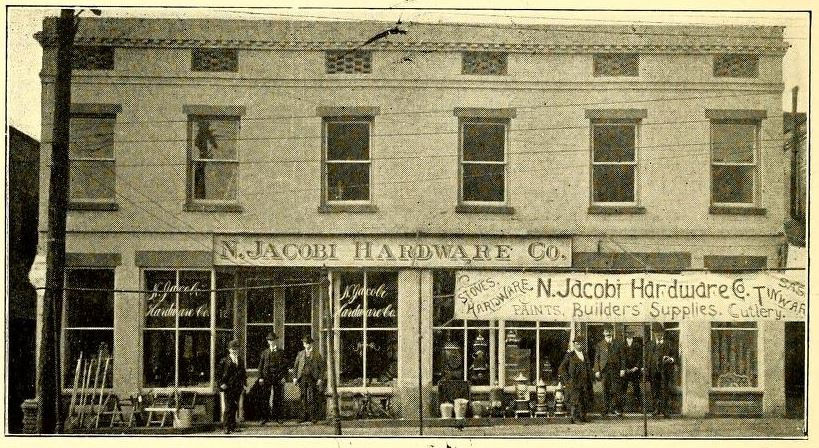
The longest lasting business on the block was Jacobi Hardware, which opened in the 1870s and remained there until about World War II, when a men's clothing and jewelry store would remain until the 1980s. The building was then demolished and left the parking lot and the shell of the old warehouse that we see today.
But I didn't go to school and learn these things. I didn't even pick up a book. I put some boots on one Saturday morning, went downtown, and broke a sweat. And you can, too.
Meet the Corps
That Saturday, I wandered down Quince Alley, armed with a cheap notebook and an iced coffee to find a quiet but busy group of people excavating inside the "original Blue Post" in a carefully dug pit about six feet deep 30 ft long and 10 ft wide. Piles of chest high dirt sat in corners sprouting bright pink rose of sharons. In one corner of the pit lay a great millstone, and several pilings lay in the middle partially unearthed in the wet dirt. One side of the wall was covered by a tarp, part of a recent collapse, and no longer available. The building is a shell–held together by steel girders from the inside, a skeleton built long after the skin.
Soon, a tall rugged man and dirty boots greeted me. His name is Jon Schleier, and this is the Public Archaeology Corps (PAC). The PAC is a group of volunteer and professional archaeologists dedicated to unearthing Wilmington and working with property owners to document, catalog, and preserve our history on private property. This mission is unique because while there are many guidelines on preserving artifacts on public land, generally private land is left to the owner's discretion.

And according to Jon, this is the beauty of the PAC. They work directly with developers and land owners to dig and archive their findings. Whatever they do find is given back to the owner.
"When we come and say 'Hey, we're not trying to stop you, we're not even asking you to delay your schedule–just let us come in and document the space,' then everyone gets real friendly after that," Jon says with a chuckle.
Some of the PAC's most notable digs are the Orange St. Cistern, The Civil War Battlefield at the Cameron Art Museum, and most notably, the Rock Spring at the Water St. Parking Deck. The spring and the parking deck are both gone now, replaced by the Riverfront apartments, but the spring and its location were important to document as it had been a source of fresh drinking water for people in the Wilmington area since before colonization.
But how did such a unique organization come to be? According to Jon, the idea came to him riding in the back of a concrete truck with other archaeology enthusiasts. Jon had been doing cultural resources management for years doing what he calls "shovel-bumming" (taking short-term archeology work in different locations) but wanted a more stationary position. He landed a gig at Camp Lejeune but found himself doing concrete work to pay the bills after an unexpected layoff. It was here that the idea of the PAC took root. He soon took another archaeology job at Fort Bragg, and then he contacted UNCW and the Historic Society to take the first steps into developing the PAC.
They are now pursuing non-profit status to take the organization to the next level. They've elected a board of directors and already have an impressive group on staff. It is the only organization of its kind in North Carolina, and possibly the south east.
Aside from local community volunteers and multiple interns from different universities, the PAC has Pat Garrow as their lab director. Pat has excavated history all over the country, including Civil War finds from the Battle of Atlanta, prehistoric investigations in Puerto Rico, and the Ronson ship from the 175 Water Street block in Manhattan in the mid 1980s. On the day that I met him, he was particularly entranced with a set of colonoware tobacco pipes made by artisans of the Catawba tribe from the post-1750 epidemic. He told me that he enjoys the work because so much of history isn't written down, and when it is, it's usually by and for the wealthy—but he says that it's "possible to write history from the ground" too. And while the initial "treasure hunt rush" is exciting, the true value comes from filling in the historical record and telling the forgotten stories.
Then there's David Norris, a jovial artist by trade whose passion for storytelling is unmatched. David is considered the resident historian of the PAC and regularly educates and posts significant PAC findings in online channels such as Facebook. He's one of the few folks I've met who has these histories mapped clearly and elegantly in his mind. In a very short conversation, you can point in any direction downtown and he will pull a piece of history out from behind your ear like a magician with a silver dollar.
He shared the locations of many former major and unique businesses in town, such as Isaac Belden's Oyster House, the Old 76 (a tavern and coffee house very near to where the present Concorde stands), and Dorseys' Tavern, which was the largest establishment of its kind in its time in Wilmington, boasting twenty rooms and stables for rent and standing where the old Baileys Theatre once operated (it's currently an open lot across the street from Front St. Brewery).
David was also kind enough to show me tax records and old fire insurance maps that clearly show where Dock Street used to be, well, a dock all the way to Front Street and where a great windmill used to operate in what is now the intersection of Orange and Fourth Streets. I experienced a subtle sense of motion sickness as he placed the transparency maps on top of one another, each bringing the map closer and closer to the present, watching stationary locations become liminal in time. I watched as the riverside shore was slowly filled in and molded into the shape we now know it. The east bank of the Cape Fear River used to match the west. The next time you watch the sunset over dinner downtown, know that you are also seeing Wilmington as it was 280 years ago.

Unique Finds
The Quince Alley Millstone

Mochaware
Mochaware fragments found in Quince Alley. Courtesy of the Public Archaeology Corps.
Georgian-era Tobacco Pipe Bowl

Early Wilmington Maps on Transferware Plates

Bone Handle Brush

Can You Dig It?
Yes, actually! In fact, it's a core tenet of the PAC to encourage and invite the public to volunteer or just help out. During digs, any adult is welcome to come to the site and break sweat, and adults and children are welcome to come to the PAC lab and clean and organize artifacts.The PAC is always looking for new ideas, pitches for new sites, and volunteers! If you or the Indiana Jones in your family is interested, visit the PAC Facebook page or website.


