
LIFE, LOVE, FAITH, AND SO MUCH ART: ‘Woven Together’ combines words and images by Helen Mirkil and Brian H. Peterson


The exhibition “Woven Together” opened back in September and remains on display in the Creative Light Gallery at theArtWorks through January 10, 2027. Featuring artists and partners in life Helen Mirkil and Brian H. Peterson, the two artists will discuss the works at this weekend’s Artist Talk, Reading & Book Signing event on Saturday, November 21 from 2-4 p.m. A portion of any proceeds go to Michael J. Fox Foundation for Parkinson’s Research—a cause they’re especially close to since Peterson’s own diagnosis 20 years ago.
“I expect there is something I can say from my 20 years of living with Parkinson’s that might help someone else,” Peterson says. “Don’t give up. I thought my life would be over in five years. But some of the best writing I’ve ever done, as well as one of the most personal series of photographs, happened after my diagnosis. Last week I came up with an idea for a new creative project. I’ve even taken photographs in the EMS van on the way to an emergency hospital visit. So your life isn’t over.”
Mirkil and Peterson moved to Wilmington from Philadelphia, where they both built artistic careers and garnered recognition. Peterson’s photographs are featured at Philadelphia Museum of Art, the Amon Carter Museum of American Art, and the Virginia Museum of Fine Arts. Mirkil’s paintings and drawings are found in collections of the Woodmere Art Museum, the Michener Art Museum, and the Philip and Muriel Berman Museum of Art.
“We share our lives, our ideas and experiences, yet our artwork comes through in very different ways,” Helen Mirkil says. “The last time we had a show together was in a church parish house in Pennsylvania, probably 40 years ago. We are truly enjoying this new and very different adventure together.”

After Peterson’s diagnosis in 2006, he continued his role as Chief Curator at the Michener Art Museum before he retired a few years later. He also wrote “The Blossoming of the World,” which includes his reflections on his diagnosis.
“In a funny way, Parkinson’s was a gift,” he shares. “Parkinson’s was an explosion of fear and pain, but on the other hand, it made life real somehow. It [life] had been too comfortable. The poet Rilke, in his Letters to a Young Poet, states: ‘Surely all art is the result of one’s having been in danger, of having gone through an experience all the way to the end, where no one can go any further.’”
The two left Philadelphia for Wilmington in 2019 and set up a studio at theArtWorks. As an artist, Mirkil describes a friendly and welcoming space, a lively place that is ever growing and expanding with themed exhibitions and artist community. “There is much to learn and observe in the studio conversations from working in a building with other artists,” she notes.
The move also brought them closer to their six grandchildren—an abundant source of joy and inspiration—in this chapter of life and artwork. In fact, half of them helped to set up their “Woven Together” exhibition.
“I am privileged to be living close to them and to be an ongoing part of their lives,” Mirkil adds.
“The other aspect of living here [in Wilmington] is community. I am a part of a thoughtful and rewarding church community—good friends, a book study group, praying and singing and eating together, reading the Word in services, assisting with communion, and more. The message preached from the pulpit at my church, St. John’s Episcopal Church is as close as it gets to the pure Gospel, in a way that is grounded and relates to everyday life, and that is rare. In addition, my church is a place where the arts are supported.”
The two artists combine their collective written works, poetry, photography, drawings, and paintings to tell deeper, more complete stories of their shared experiences but most especially their shared faith and love of the Divine.
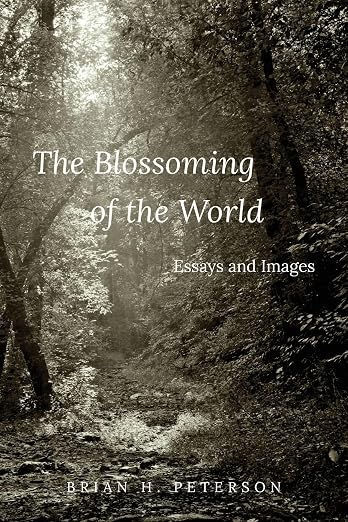
Peterson’s book “The Blossoming of the World: Essays and Images” (2011) mixes essays, journal entries and photographs, he says, to give the readers “a fuller picture of the gifts I’ve been given and a window into my spiritual life.”One reviewer said the book tries to reconcile Christian faith with a love of science and creativity.
“I feel no conflict between my Christian faith and my love of science and creativity,” Peterson responds. “Descartes said, ‘I think therefore I am.’ But that is very narrow. Both science and faith need each other, like in music, how its structure and emotional aspects are intertwined.”
On November 21, Mirkil will read from her 2013 poetry book “Sower on the Cliffs,” which also features 10 drawings to correspond with each chapter theme. Sometimes in a literal way, as with the chapter “soul mate" featuring a drawing of her husband. “Other times it's in an abstract way,” she continues, “as with the chapter ‘amazing grace,” which features a pen-and-ink landscape and is followed by poems about dreams and/or God.”
The cover of the book also features a painting depiction of The Sower, derived from the parable in the Bible. Mirkil joins several artists (Millet, Daumier, Van Gogh, and Francis Bacon) who have painted a depiction of The Sower, a symbolic story that tells of scattering seed (the Gospel) and under what conditions do the seeds grow.

“In my painting the Sower is a woman,” Mirkil explains. “I see her as representing me, the poet, scattering seeds (i.e., offering my poems to a wider readership) and the ‘Cliffs’ as the feeling of adventure, purpose, insecurity, and even a feeling of danger (poems about the Lord are not widely accepted in the poetry community nor do they fit into a popular genre!). Sower was my first poetry book and for me it was therefore a kind of “coming out” as a poet, and as a poet writing from a place of faith in Christ.”
Mirkil’s poems move between faith, motherhood and small everyday moments, a collection from which she will read on November 21. She says of her collection, she is most proud of the poem “Drop Slowly.” Reproduced on a text panel in “Woven Together,” it is the final poem in her upcoming poetry book, “From the Whirlwind.”
“It came through me, needing little to no editing, little to no additional lines or thoughts,” she describes writing the piece. “That almost never happens. I feel as if it came from above, and I got out of the way to let it happen.”
“From the Whirlwind” is Mirkil’s second poetry collection, albeit from a time of great losses in life. “Beloved friends and family members were dying, our beloved dogs were swiftly reaching the end of their lives, and my husband’s Parkinson’s disease was progressing to the point where remaining in our home of 20 years was becoming too challenging,” she describes. “It sounds like a very depressing book . . . however, a wise person once said (was it Maya-the-sage-Angelou?) that when you grieve, the level of grief is commensurate with the depth of the love you have/had for that person. So it is a book that contains a great deal of love.”
During her tenure, Mirkil has worked in landscape, flowers, self-portraiture, collage, figurative series and terra cotta sculpture. She says each medium speaks to her in a different way. “Each has its own freedoms and restrictions, joys and frustrations,” she notes. “It’s as though creativity is the language and the different media are dialects.”
“Conversations” is a series of figurative paintings Mirkil says were inspired by paintings of famous artists (Van Gogh, Cezanne, or Alice Neel). In this series she provides a “dialogue” with a painting and it “speaks" to the viewer, whatever the message may be to them, and they “reply” in their personal response to it. Like a “three-way conversation” spanning across time.

“Part of my dialogue is also a dialogue with a specific painting in art history and the famous artist who painted it,” she continues. “The viewer is therefore connecting to my work as well as to the work of an historical artist, even if it’s subtly implied. I feel a painting is finished when its “voice” is clearly expressed, but not underlined (ie, that the painting becomes overworked), because overworking can kill the life in a painting. Once I create a painting it begins a journey of its own. Interpretation is in the eye of the beholder. I do not claim to know the only interpretation of my paintings, in fact, I’m delighted with hearing interpretations that would never have occurred to me.”
Peterson’s own work has gravitated to improvisational drawing, a medium that requires little equipment (only paper and pen) and less planning. While he has no classical training in drawing or painting, Peterson notes that what he’s produced has no preconceived rules (as opposed to photography). “But all the years of making photographs have taught me how to trust myself as an artist,” he explains. “So I can be more spontaneous, and more confident with wherever the drawings take me.”
“Woven Together” will feature the improvisational drawing he describes. Peterson’s photographs are often described as rooted in a symbolism of light. In both mediums, he says, light and rhythm wind through his work.
“The photos are about light and also about rhythm. The drawings are about rhythm and about expressing various emotional states. Light is an expression of the sacred. There is a long history of this going back to the design of the Gothic cathedrals. I had many ecstatic and deeply spiritual experiences in nature. Light, for me, is a manifestation of the Divine.”
Both Mirkil and Peterson describe a sense of music, rhythm, or melody in their works. For “Woven Together,” Mirkil’s work is described as drawing on “an internal music.” Music, singing and dancing were integral parts of growing up and she says she almost always sings, hums, whistles, dances, drums, or at least has the radio filling the air with 1960s-80s rock, soul, classical jazz, big band, classical music, or gospel music.
“Music is fused with movement and dance,” she continues. “It’s all in me from years of osmosis! In a sense, the music I hear is spiritual. It’s the Holy Spirit singing to me from my heart.”
Peterson has years of music composition studies in his repertoire as well, and says music creates atmospheres, mood, and emotion. “It’s also very structured,” he says. “My photographs are both structured and expressing emotion as well, in differing combinations. ‘The Forest Light’ series is very linear where the ‘From…to’ series is more overtly emotional, however, both have elements of each characteristic.”
Photos from Peterson's 'From...to" series.
