
SOUND, LANDSCAPES, AND STRANGE-LOOKING FLOWERS: Poet Anna Lena Phillips Bell releases "Might Could"

Updated: 2 hours ago
I sat down on a spring afternoon with poet Anna Lena Phillips Bell to talk about her new book “Might Could." Winner of the Anthony Hecht Poetry Prize, “Might Could" explores the floodplains of North Carolina, the flowers that grow along the riverside, what it means to call a place home, and the juxtaposition of loving and grieving for an environmentally traumatized landscape.
In “Might Could", you’ll find the Cape Fear River alive with mosquitoes and hurricane wreckage, lightning bugs on a quiet night, and songs for the summer solstice buzzing next to blooms of primroses and leatherflower. Language and sound come alive in this incredible collection crafted by a master of meter and formal prosody, boasting a powerful crown of bref doubles running throughout alongside sonnets, villanelles, and roundelets. Anna Lena Phillips Bell makes writing poetry seem as effortless and meditative as wading through the riverbank looking for flowering plants.
Kate Barber: I loved how music was the focus of the foreword of this book. Shane McCrae, who chose the book for the Anthony Hecht Prize, writes that “an overwhelmingly musical poet is a poet who makes the sound of words so thoroughly their first concern that a reader can be tricked into thinking it’s their only concern.” How do you approach sound in your writing? What role does music play for you?
Anna Lena Phillips Bell: Shane’s foreword was very generous, and it’s very generous of you to make the connections you have, too, so thank you! Sometimes when I start drafting a poem, it's clear that sound is going to be the thing that is kind of in charge. Of course, I also always want it to work in service of what the poem is doing. I find the devices of formal prosody to be so helpful in getting a poem to do something interesting. I really enjoy writing sonnets. I think it’s so fun. A sonnet that has a rhyme scheme and a particular meter is a such a pleasant shape to occupy for a minute. There are other times when form is helpful because it lets me get my mind out of the way. When one part of your mind is busy figuring out how to make the rhyme scheme work, the rest of you can do something interesting and fun that wouldn't have been possible otherwise.
KB: I love that. When you’re considering how to start, how do you decide whether to start with a form? Is it a decision you make before starting, or does the poem take on a form as you go?
ALPB: It happens all kinds of ways. Sometimes I'll just start with a loose number of beats per line—I like to work that way right now—and then rhyme will emerge. I shift things around a little bit in revision, and suddenly there's a rhyme scheme that I've just unearthed in the poem. Or there isn’t any rhyme, and that’s okay too. Other times I do start with a fixed form and try to adhere to its constraints as I write. So it really depends. I think starting from either place can be really fruitful.
KB: I know you love poetic forms, and you have several different types of forms in this book. Do you have a favorite?
ALPB: No, I love so many of them! They all serve different purposes. There are a few poems in this book in various of the French repeating forms, which came out of the troubadour tradition in France centuries ago, so they have an origin in song. They have a lot of repeating phrases and repeating lines, kind of like a song would. I knew about them for years, but hadn't found the poems that needed those forms yet. And then suddenly it’s like, oh, this poem needs to be made in this form, so I’d better learn to write in it.
KB: I didn’t know so many of the forms were French! Neat. Okay, I know you also love meter. How do you choose the right meter for a poem? And how does meter affect how you go about revising?
ALPB: I do often choose a meter to write in. Sometimes, I'll just start writing and hearing the beats, and then it will become clear to me how many beats in a line the poem wants. Of course, some poems and fixed forms have a set meter that can be fruitful to abide by from the beginning. The meter that most people have heard of in English is iambic pentameter—because, of course, Shakespeare—but there are so many other possibilities. There are triple meters that have little three-syllable sets. They're useful for serious work, as well as for things like a limerick. Sometimes, meter will help me to make the poem on the page match the way I would read it out loud, even for a reader who's not from where I'm from. There are words we pronounce here in Wilmington, in the South, that the meter can help clarify. Like: this is how this word wants to be pronounced.
KB: Oh, I love that! It’s like when you’re reading Shakespeare and you have to pronounce a word in an odd way to get the rhyme, but that lets you understand how the pronunciation was back then.
ALPB: Yeah, that’s exactly it. Sometimes with regional speech, people feel pressured to not talk like where they came from. I think the ways we talk are worth preserving and recording in a poem. Meter lets you do that. In the poem called “Common” that’s in this new book, there's a line about the police cars that drive too fast up and down my road. Because of the meter, the poem tells you that you have to pronounce “police” as police, with the first syllable stressed,not the second, which is, of course, the way you're supposed to say it.
KB: Yes! That’s such a great example. Can you talk a little about music and the role it plays in your life and your writing life?
ALPB: Studies show that our brains perceive poetry the same way they perceive music. It’s really an altered kind of text—it's not the same as prose. Poetry is powerful, and it can make things happen. Sound is a huge part of how it does that.
KB: That’s so true! I’m curious what you were thinking about as you wrote this collection as a whole. How was writing it different from writing your first collection, Ornament? Was there a question or idea you were exploring?
ALPB: Ornament was my first book, and some of the poems were 20 years old when it was published. I wrote “Might Could" over the course of 10 years, and it pretty much coincided with the 10 years I've lived where I live now, next to the river. I was thinking a lot about trying to make a life in this beautiful but compromised landscape we live in, here at the bottom of the watershed. We get a lot of stuff that people farther upstream don't necessarily get. In Wilmington, we are at the crux of the climate crisis, and that means that we have the responsibility to witness it and, potentially, the chance to help change things if we're smart about what we do.
KB: What are some different things you see where you live in terms of the climate crisis that we might not see further downtown?
ALPB: One thing is how verdant and abundant the ecosystem alongside our river is. There are wild plants making very strange-looking flowers that we would miss unless we stopped to get to know them. This place we live in is rare and beautiful. My family and I also have a very close experience of the environmental trauma that we experience in this ecoregion. We’re on well water, and our well and many others’ are contaminated with PFAS, a lot of which comes from the Chemours factory in Fayetteville. We actually had a new well dug in the hope that a deeper well would avoid the PFAS, but it didn’t matter. PFAS can disrupt people's endocrine systems; they can raise our cholesterol and decrease our fertility; they increase the risk of prostate and kidney cancer. And these chemicals are part of our daily lives in a real sense. It gives me such appreciation for the work that Clean Cape Fear and Cape Fear River Watch are doing to try to improve the situation.
KB: Wow. Yeah, we’re absolutely at an environmental crossroads here. You mentioned strange-looking flowers, and I loved how many flowers show up in your poems. Can you talk about the flowers that appear?
ALPB: The plant kingdom was a great companion to me growing up in a rural place in what's now called South Carolina. Since this environment is newer to me, getting to know the plant life has been so fun. Flowers are why we're here, right? We could not live without them, and so it seems important to pay attention to them. But also, they're just delightful. They're doing the thing that they do to survive in the world, and the thing that they do to survive creates the conditions for delight for us. Spending time with them is the best. I feel an affection for all flowering plants, but especially for the plants that are native to this landscape, that evolved with this landscape, that are maybe less widely known.
KB: I noticed in the back of the book there was a note that most of the flowers were native to North Carolina, which was really neat. Is there one less-known flower people should go hunt for?
ALPB: One flower that's about to bloom here, my partner calls purple church bells, but it's actually called leatherflower. It's a vine like most in the clematis family are, and it crawls all over things, and then the flower will sort of descend from its stalk. Its bud is a purple teardrop shape, and then when it opens the petals curl up, up, up in little tips all around it.
KB: I’ll have to go find those! Okay, last one. If you had to say this book was about one thing, what would you say?
ALPB: Well, this is broad, but it's really a book about how to make a life. How to make family. How to live in a landscape that is threatened and compromised while still appreciating it. How to experience environmental trauma alongside a landscape and still learn to be happy. Most of “Might Could" was written here at home. It’s a product of this particular landscape. Writing the book made me love this place more.
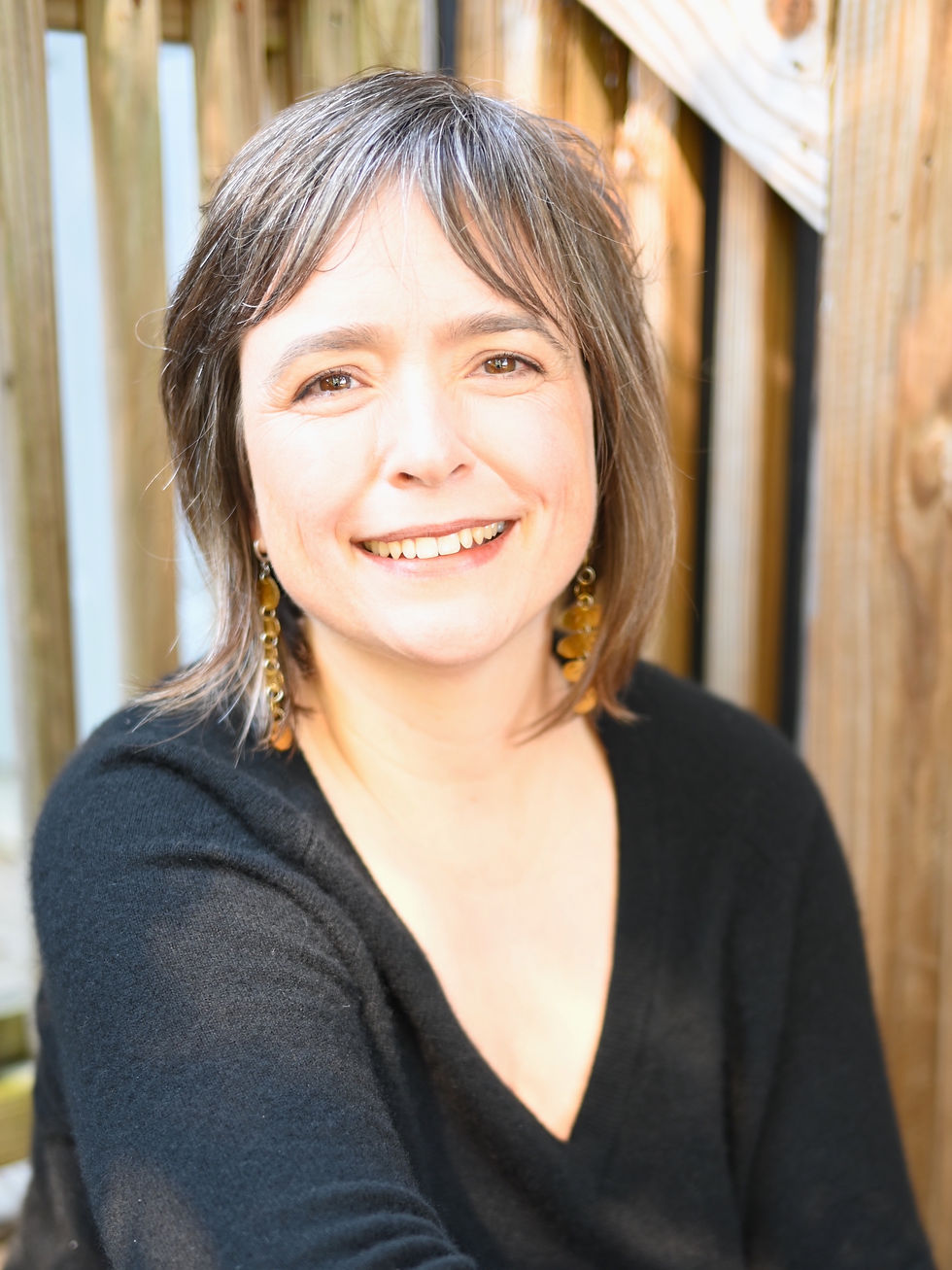
Anna Lena Phillips Bell is the author of “Might Could", winner of the Anthony Hecht Poetry Prize, released in March 2026. She is also the author of Ornament, winner of the Vassar Miller Poetry Prize, and the chapbook Smaller Songs, from St Brigid Press. Her work appears in Orion, Electric Literature, Oxford American, and Lit Hub, and she is the recipient of a North Carolina Arts Council Literature Fellowship and the Winter Anthology Award. She teaches in the creative writing department at UNC Wilmington, where she has served since 2013 as the editor of Ecotone. She lives with her family near what’s now called the Cape Fear River.
Rules for Proximity
by Anna Lena Phillips Bell
Tonight the rule is
you can be with
the tree frogs from over
the river saying
everything, everything,
each with its syllable,
each its own
note, overlapping
jubilations;
cat in the window,
satisfied,
drinking the night
as you do, but better.
The rule is you
can hear them in all
their clamor if
you’ll also breathe
something past rotten
or rotted by purpose—
breeze through the screen
and frogs, if you don’t mind
wondering again
if it’s the landfill
or maybe the factory
that’s in the newspaper
every so often
for making the air
even in town
smell like cat piss.
“Harmless,” the factory
says to the paper.
Do the frogs smell it?
Sense it with eyes
and skin? All evening
they breathe and call
anyway, anyway,
tonight or a night
when the rule is different—
open the window,
the cat leaps up
and the scent is only
its own self: myrtle,
pine; faintly,
salt, the inside
air enlivened
and loud, loud,
the frogs making
together a sound
that you, poor human
approximator,
might call supreme
kazoo, might waltz to,
everything, everything—
or skip to, sometimes,
a million, a million.
When it’s there
the smell recedes
after a while,
or your brain stops noticing,
though you’re still
taking it in,
accepting the bargain—
either way, though
you can’t see them, or
because you can’t,
you feel the shapes
of their million calls
piling up
in the dark of the low bank
across the river
where, lately, yellow
primrose blooms
in daytime, and now
these bright triangular
pebbles, or petals,
made with air
and carried by air
to and through
the window, to
the cat’s ears, your ears,
staying as loud
as they are, if you listen—
This article appeared in our Spring 2026 Volume 2 print issue.


