
WHAT WOULD WE TALK ABOUT: If we stopped talking about him?
Mary Trump came to Wilmington to tell Wilmingtonians to do what she can’t: talk to people with different views in a purple state and convince them to vote blue.

It’s a sunny Saturday evening in late August, and Election Day is ten weeks away. Mary Trump is coming to Wilmington, where she will be the keynote speaker for the New Hanover County Democrats’ 2026 Unity Banquet. Trè Ricanek, the third vice chair of the New Hanover Dems (and Encore Southeast board affiliate), dressed in a purple suit, seems to know what’s going on at the Convention Center. There’s no deep reason for her being here, he says—no speaking fee, endorsement, or announcement. “We asked, she said ‘yes.’”
Before her speech, we’ll meet in Room 104. I’ve been told we’ll have twenty minutes, but she’s late. Twenty becomes ten. She arrives with a small entourage, including a young man who is clearly a handler of sorts—Alex Schaefer, chief of staff. “You’ve got…five minutes,” he says.
If you know Mary Trump, you likely know her as the niece of the President. She’s the clinical psychologist who penned the tell-all Too Much and Never Enough: How My Family Created the World's Most Dangerous Man, which sold 1.35 million copies the week of its release in July 2020, after Donald Trump’s brother Robert unsuccessfully sued to prevent its publication. In it, she argues that her uncle was a victim of child abuse—neglected by his mother, who fell ill after his birth, and raised by a “high-functioning sociopath” father, whose lack of empathy and commitment to deceit he had to adopt to survive, until these adaptations hardened into personality. The White House called it a “book of falsehoods.”
Mary Trump has spent the last six years sounding the alarm on her estranged uncle. She refers to him at once as “a little boy” one who desperately desires to be loved and a “monster” of the likes of Frankenstein (she holds a bachelor’s and master’s in English literature). Scroll through her Instagram or listen to her podcast, and he still dominates the conversation.
On camera, she’s confident, talking to hosts like Anderson Cooper and Wajahat Ali like they’re old friends. In person, dressed in a no-frills black pantsuit, she seems smaller, shyer, and more careful with her words, the way she was with George Stephanopoulos of ABC News after the release of her first book. The hard question he asked anyway: Is writing the book an extension of the family’s dysfunction? “Probably,” she said.
She’s said at times it feels like she’s screaming into the void, but her adversary may be getting weaker. Trump’s overall approval rating sits at 32 percent in the most recent Focaldata/Financial Times poll, with 69 percent disapproving of his handling of inflation and the cost of living. Does it feel like she’s finally getting what she wants? She chuckles. He is not going to prison, and his enablers must be held accountable. But there is an end in sight. “He is declining across every category of being human—cognitively, emotionally, psychologically, and physically. And we can see it,” she tells me. “At one point, he will be completely incompetent, and there will be no propping him up anymore.”
The President’s second term ends at noon January 20, 2029. No matter his impact or legacy, someday, he will no longer be the center of American politics.When you scrutinize Mary Trump and her uncle—their stories back-to-back, in her own words—there are similarities: Trump was neglected. Mary was also neglected by her mother, who delayed taking her to the hospital when she struggled to breathe due to her asthma, and she was neglected by her father, too, who battled alcoholism throughout her childhood. She once witnessed her father pointing a rifle at her mother’s head, laughing, drunk, and threatening to kill her, when she was not yet three years old.
So why did her life look so different from his? “I had the advantage of being my grandparents’ grandchild, not their child,” she tells me. Raised in Jamaica, Queens, working-class and ethnically diverse, with summers at a sailing camp on Cape Cod as a respite from her parents’ chaos, she was exposed to other ways of being in the world—and an escape. “Those two things grounded me.”
Full disclosure: I’m a health writer who typically covers family trauma, not politics. What I most want to ask her about is what I view as her core wound. Does she view her mission, on a personal level, as avenging her father? She grew up ashamed of him, viewing him as a “drunk” and a “loser,” the same way her family did. She only got to know the good in him—his career as a pilot, his National Guard service—through stories from his friends, after he’d died. What stuck with me most was her belief that her grandfather and uncle “destroyed” her father. Strong words. So I have to ask: Did she view their relationship as abusive?
This is the only question that seems to make her pause. She gives a quick summary of the story I already know. It’s a near-biblical tale of two brothers: As she put it, her father was punished for being a kind and sensitive child, failed to meet the patriarch’s impossible expectations, and became a pilot instead. He left the family business, but by then, the bitter seed of shame had been planted. Both his father and his brother, Donald, dismissed him as nothing more than a “chauffeur in the sky,” she claimed. He faltered, repeatedly, until he died of complications of alcoholism at 42. Mary was 16.
“The thing that broke him,” she says, “was the fact that my grandfather got a lot of joy—to the extent that he felt joy—from humiliating people who were weaker and less powerful than he was. And Donald does the same thing.”
She takes a breath. “The apple doesn’t fall far.”
The clock runs out, my five minutes stretched to ten. I thank her, and she’s off to circulate.
Outside, I ask a young woman, a UNC-Wilimington Dem working the door, for her thoughts on the rise of the Democratic Socialists of America and trending videos of figures like Abdul El-Sayed, one of which Mary Trump recently shared. She gives me the Gen Z stare. “I don’t know. I’d have to reflect on it,” she says.
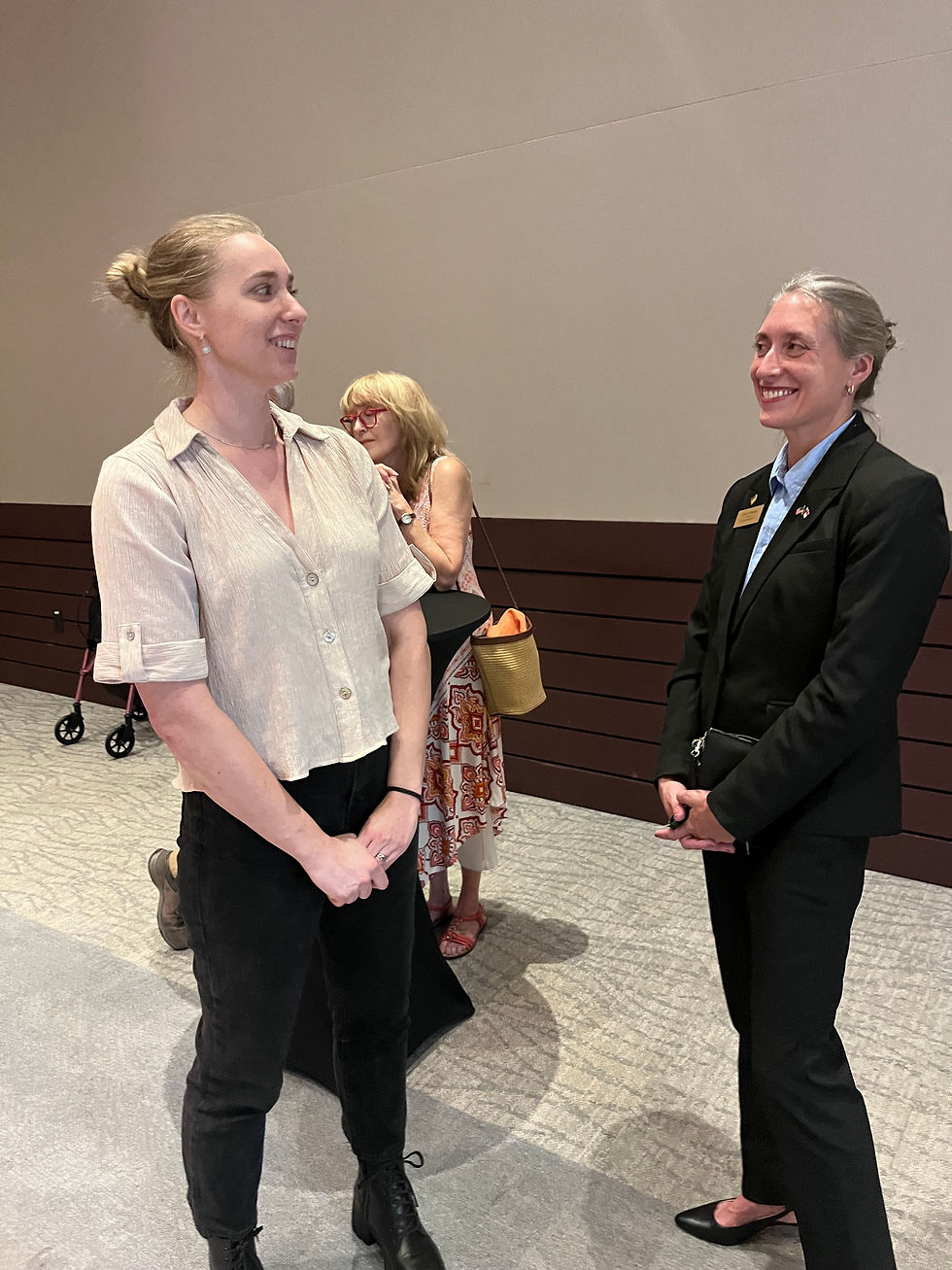
In the VIP room, Jessica Bichler, who’s running against Sen. Michael Lee in District 7, smiles with her lips closed and tells a couple at a nearby table she likes her chances. Lee’s team has just released an AI-generated ad of her body contorted into impossible yoga poses (she’s co-owner of Wilmington Yoga Center). The ad claims her campaign is supported by “extreme leftist groups” like the American Friends Service Committee, a Quaker-founded organization that “works for a just, peaceful, and sustainable world free of violence, inequality, and oppression.” Bichler denies any connection, per Port City Daily.
I ask if she’s experienced the “purple” parts of Wilmington—or only extreme divides. She says it’s part of why she got into politics. “I feel like on the national level they’re just fomenting all of this divisiveness, and it’s not my lived experience here,” she says. “I’m really optimistic that if we actually just stay on the local level and connect with the people who are right beside us, and speak frankly, and look for solutions that we can all support, we can have a great impact.”
I ask Jerry Jones Jr., who is running for the New Hanover County Board of Education, what percentage of his conversations center around Trump. “Every political conversation I have touches on in some way, shape, or form either the man himself or how his policies have trickled down to even the lowest levels of government,” he says. When his opposition to the President comes up, he pivots: he talks about moving meetings to hours working families can attend, providing childcare, and putting food out at evening school board meetings.
B’Ellana Duquesne, a retired teacher sitting alone in the corner with a full glass of red wine, says her wife is Cate Calson, the most down-ballot candidate on the ticket, running for soil and water conservation district supervisor. She says she supported her wife’s decision to run—and said she’d have nothing to do with it (much like the family dog). Then she tells me about an upcoming event next week: “I pretty much put it together, and wrote the press release.”
She tells me she’s been coming to Wilmington since she was six, when her grandfather worked the rail and the porters would pin a tag on her in New York that said WILMINGTON and wake her when she got there. She remembers drinking from the colored-only fountain. I want to ask her about Wilmington history. She wants to talk about the jazz scene.
When I pull her back to November, she admits she’s cynical. “Our nation’s politics have come in conflict with our technology and the nature of our economy,” she says. “We have become less and less a society of labor and production, and more and more a society of investment.”
Her phone buzzes—her wife. She has to go. A voice cuts across the room: “Grab your last cocktail. The program is going to be kicking off in ten minutes!”
The banquet hall is filled with gray and white hair. There are a few young faces, but not many.
Kimberly Hardy, running for Congress against David Rouzer, gives a rallying cry. She says her internal polling has her six points behind in a district Rouzer won by seventeen. “Six points is not some immovable wall,” she says. “It’s doors we haven’t knocked yet.”
When it’s Mary Trump’s turn to speak, she walks out to D.J. Khaled’s “All I Do Is Win.” She shares the oft-shared anecdote about her father dumping a bowlful of mashed potatoes on young Donald’s head—an incident that he supposedly still fumes about—then launches into a pep speech.
She sarcastically describes herself as she’d been caricaturized by the right: “a liberal, Marxist, communist.” So why is she here? “I can come here and talk to you and meet with you, but I can’t go out and have the kinds of conversations that have to be had with your neighbors.”
The message fits the contours of the usual: get out there, talk, fight, win. Start from grace. A lot of people who voted for this, she says, “have been lied to for decades.” She encourages asking questions like, “Is it okay with you that a government agency is murdering Americans in our city streets? Is it okay with you that we are giving to billionaires and corporations while depriving our children of essential services? Is it okay with you that government policy is now grift and corruption?”
These are questions, I imagine, that would not be received well by those to the right of center. They sound accusatory, shouted across the river where a bridge burned long ago used to stand. Or, in Wilmington’s case, all over a gerrymandered map.
District 7 was drawn to exclude downtown Wilmington, pushing thousands of left-leaning voters into District 8, which crosses into Brunswick and Columbus, firmly red counties. In 2024, those voters gave Sen. Bill Rabon 2,910 votes and his Democratic opponent 10,580; Rabon won by 20 points anyway. Over in District 7, Lee beat his Democratic opponent David Hill by 9 points. Had those voters stayed in District 7, Hill would have won by 268, according to The Assembly.
The personal and political, the national and the local. They all intersect here. Mary Trump talks to her uncle via lawyers. She’s been estranged from multiple family members for the entirety of her adult life. One in three Americans have cut off family or friends for political reasons, with an uptick starting in 2016. Some of us at the table where I sit share similar stories: dads and cousins we don’t talk to, concerns for granddaughters, questions with no easy answers. Do we even have a democracy anymore?
“As New Hanover goes, so goes North Carolina,” Mary Trump says, “and as North Carolina goes, so does America.”
Tomorrow, she flies out first thing in the morning. No time for a burger at Winnie’s. She leaves Wilmington Dems with the directive to keep talking.
I think back to Jerry Jones Jr. Earlier that evening, he’d told me about his first day canvassing. A woman stopped him partway up the driveway and asked if he was a Democrat. He said she was.
“So I don’t want nothing to do with you,” she said.
“All right, ma’am. Here’s my card,” he said.
“I don’t want nothing.”
“Okay. All right. You got it.”
And off he went, on to the next house.
