
CONVERSATION TO ACTION: encore attends the first Community Conversation at Seabird with Cape Fear River Watch

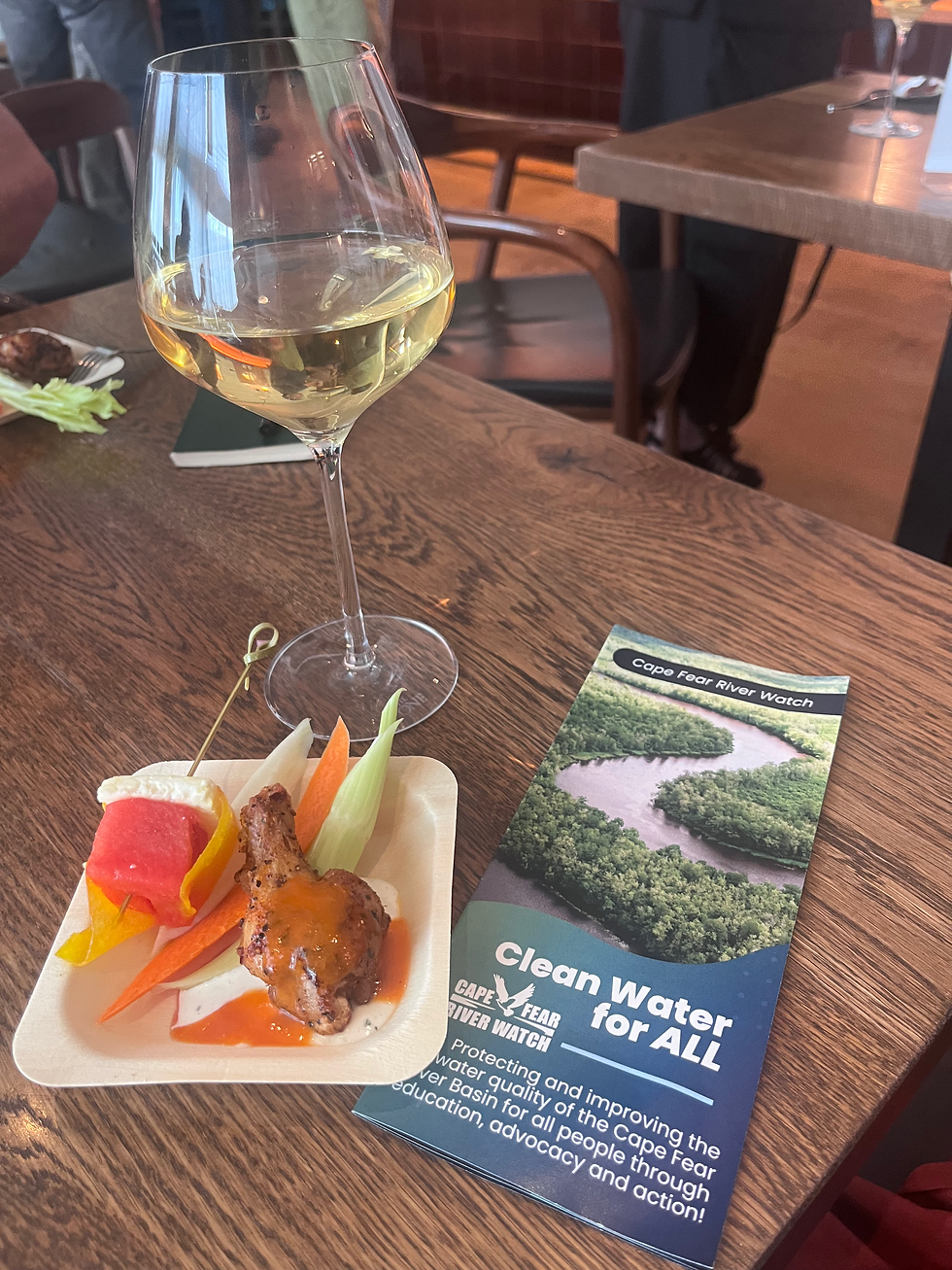
On the evening of September 22, myself, encore publisher Shannon Rae Gentry, and around 50 other members of our community gathered in the ornate dining room of the Seabird restaurant in downtown Wilmington for the first of a series of Community Conversation events, organized by Chef Dean Neff and Cape Fear River Watch’s Kemp Burdette. Over exquisite canapés concocted by the Seabird kitchen team and freshly farmed Stump Sound oysters courtesy of N Sea Oyster Company, plus enough wine and tiny bottles of High Life to lubricate conversation, we settled in to listen and later converse about the threats facing our local environment, and figure out ways we all could get involved to do something about them.
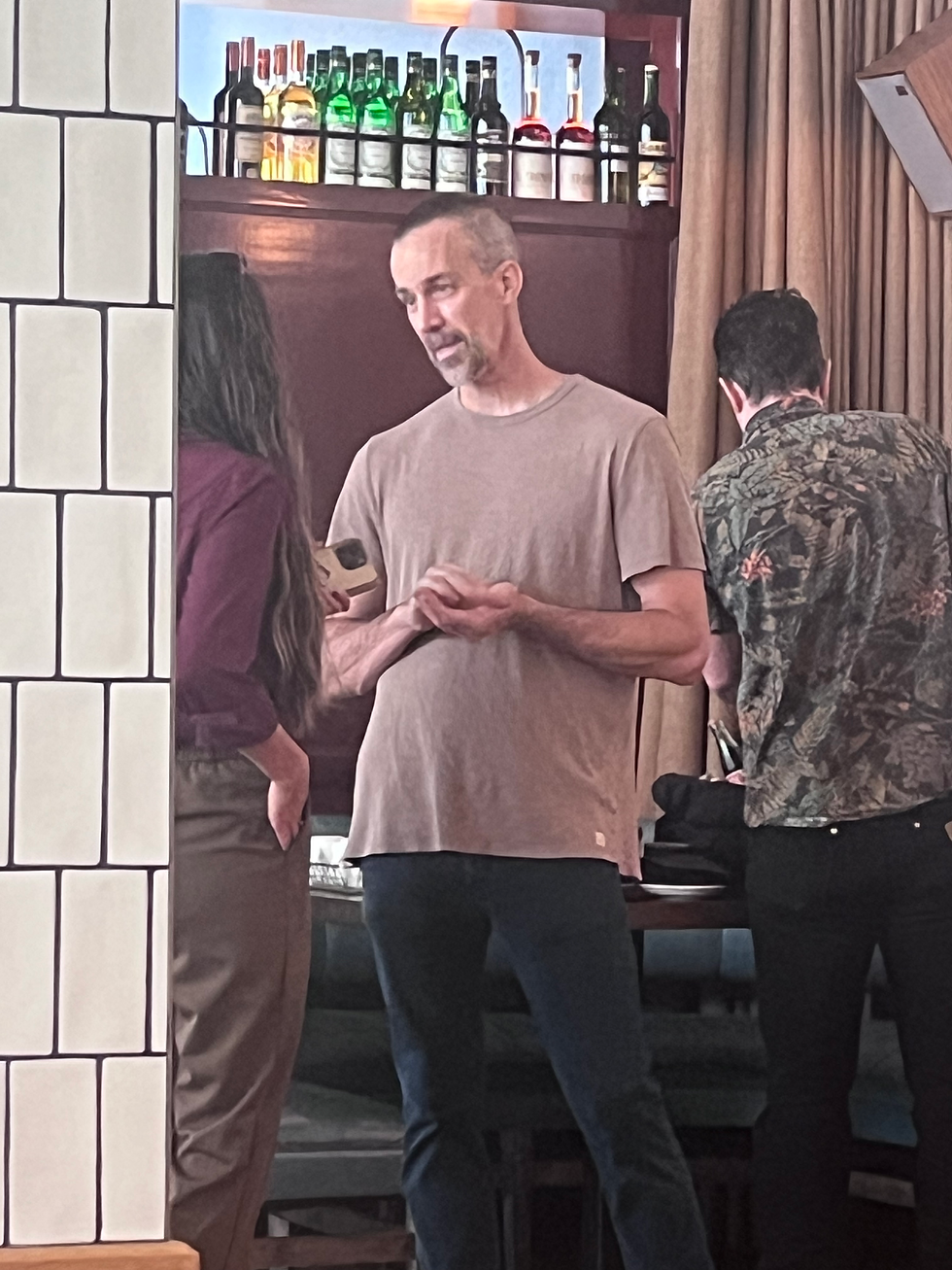
Chef Neff spoke first, welcoming everyone into his restaurant and setting up the series, framing it as a group that meets regularly to figure out deadlines for community advocacy and action, and tries to answer the question of how we can best advocate for our community. He also mentioned an upcoming event at Thalian Hall on November 9, a benefit evening of local film and fine food, where attendees would be treated to more Seabird concoctions as well as entertainment of two films about local oyster culture. After expenses were met for the food, Neff pledged that the profit would be split 50/50 between Cape Fear River Watch and Oyster South. Mark your calendars for a good cause.
Then it was time for the entree of the evening: an informal presentation by and discussion with the Cape Fear Riverkeeper, Kemp Burdette. Burdette set the stage by giving some background on the Cape Fear, mentioning how important it has always been for the state of NC both economically and environmentally, and how unique the system is. A place of jumping sturgeon and ancient cypress, of anadromous fish and critical estuarine ecology and nesting birds—and a place with more industrial discharge pipes than any other river in NC. He mentioned our unique position in Wilmington, at the end of the line, with our drinking water intake for our city downstream of every other community’s wastewater discharge. One in five North Carolinians drink from the Cape Fear River, he said, adding that the Cape Fear is the most diverse—and most industrialized—river in the state.
As the leader of River Watch, a 501c3 nonprofit organization, he was also careful to mention that his organization’s focus is on policy, not politics. “It’s policies that matter,” he said, adding that no party, Republican or Democrat, makes all right or all wrong decisions when it comes to caring for our water. "It's really more about understanding how policy impacts the river, how policy impacts our lives."
The presentation moved on to discussion of the main problems currently facing the Cape Fear River.
NOTE: encore magazine (and your correspondent) has covered many of these issues extensively. Please go to our online archive for more in-depth discussions on these topics.
Forever Chemical Wars
The first topic was, of course, PFAS in the Cape Fear. By now we (hopefully) all know the story of DuPont and later Chemours, whose Fayetteville Works plant has been manufacturing this constellation of “forever chemicals” involved in the manufacture of Teflon, Gore-Tex, and firefighting equipment, among other things, and who have been discharging these toxic chemicals into the Cape Fear River—and thence into every drinking water tap and faucet in the Wilmington area—from 1981 until 2017, when we discovered they had been doing it and public outcry demanded that they stop. Since we found out, CFRW has led the charge locally to work with the local government and sue the company to get them to clean up their act. Over $1 billion has been invested in cleaning up the site, not to mention that the river has been soaked in these chemicals for over 40 years, with consequences we’re still studying.
"We went through this huge, and very (I think) scary and painful time in our community where we didn't know what was happening," Kemp lamented. "We didn't know what these chemicals did to us, and we've had health studies since then. We filed a lawsuit against the company that that was discharging these things into the water, and that required an enormous amount of cleanup. Over a billion dollars so far invested in cleaning up the site, which is still not a perfectly clean site. We still don't think they're doing a tremendous job up there, but we have reduced emissions by about 99 percent. That 1 percent is still a very important 1 percent... We do not have zero PFAS in our water, and we should have zero PFAS."
The good news is that due to the efforts of River Watch, scientists, other NGOs, and local governments, the Chemours plant has reduced their emissions of PFAS chemicals into our air and our water by 99%. Cape Fear Public Utility Authority, who provides drinking water to most of the Wilmington area, has installed Granular Activated Carbon filtration which further eliminates 96% of the chemicals in our finished water. It’s not perfect, but good Lord is it better than it was, and now we know what to look for.
That’s not to say the problem has been completely solved. There are other chemicals to contend with which can slip through the filtration, like short-chain PFAS and an insidious solvent called 1,4 dioxane, which we still boast the highest levels of in the country (what an honor). And DuPont/Chemours isn’t the only source of these chemicals. We’ve learned that more are coming from the wastewater discharge stream of the city of Asheboro, who is accepting PFAS waste from manufacturers in the area and lacks the capacity to filter them out, and therefore is discharging PFAS into our drinking water still.
"So this is a community [Asheboro] that is accepting industrial waste because they get paid to do it while not treating it," Kemp told intent listeners. "So that waste just runs right through their system and then is discharged above our drinking water supply."
Your correspondent recently traveled up to that city with Kemp and others to provide public comment, and CFRW is actively suing them to stop discharge, which case remains in court—as of now, the city has moved to dismiss the case, and we’re waiting on a judge’s decision. It’s important to remember that what they’re doing is legal, a permitted discharge under the Clean Water Act.
It’s also important to note here that legality doesn’t make it ethical or the right thing to do. It was legal, for instance, for people to own other people as slaves before 1865. It was legal, for instance, to round up and execute people in Germany before 1945. There are many, many things the current American administration is doing right now that are “legal,” but also objectively unethical, unprecedented, and morally wrong. Thus, the problem continues.
Flesh Factories vs. Family Farms
The next issue discussed was the industrial animal farming that is occurring in the counties directly upstream of us. A quick synopsis: North Carolina has more pigs than people in the state, these animals are clustered in the coastal plain (roll down your window and take a big sniff next time you drive to Raleigh for the evidence), on “farms” called CAFOS (Concentrated Animal Feeding Operations), which are more akin to flesh factories than the traditional family farm you may be imagining.
"We now, as a state, produce more chicken than any other state in the country," Kemp explained. "So that means the enormous amount of poultry farms, the enormous amount of Swine Farms—both focused in the Cape Fear Basin—and those facilities don't have pipes that run into the river. Those facilities spread waste on the ground, and when it rains, that waste can be-it's not managed properly-can be picked up and washed into waterways."
These animals produce staggering amounts of waste (an equivalent amount as New York City, every day, if I remember correctly) and exactly none of it gets treated like human waste does; rather, it gets poured into festering pink ponds and then sprayed onto fields as fertilizer, where it cannot get absorbed by the plants or soil due to simple physics and instead enters our creeks and rivers as runoff every time it rains. During hurricanes, it’s even worse. (If you lived here during Florence, I probably don’t have to remind you that you couldn’t stand on the Riverwalk for weeks following the storm because the Cape Fear was in effect an open sewer that made your eyes water from several blocks away.) The satellite images taken after that storm are burned into my mind forever: black plumes of pollution pouring out into the clear blue of the Atlantic, the direct result of how this industry operates and has operated for 30 years.
"If you look at UNCW research going back 30 years," Kemp continued, "you can see a steady increase in nutrients, in bacteria, in markers for things like algae, which feeds on on nutrients, and and you can see the water quality in the Cape Fear Basin changing over those 30 years, an ever upward climb, and all of those markers that would be associated with things like animals, and so that's another threat to take place."
There are more CAFOs in the Cape Fear River basin than there are in any other river basin on planet Earth, and we are now also becoming a leading producer of poultry; with now over 1 billion chickens and turkeys in Eastern NC, on top of all the pigs, and their waste is handled (or not handled) in a very similar way.
Something to think about next time you bite into a barbecue sandwich.
Dredging Up Old Problems
The final big topic was the proposed State Port expansion. The project proposed by the Army Corps of Engineers at the Port of Wilmington would dredge and deepen 37 miles of river (and ocean, for the ocean offshore isn’t actually deep enough to accommodate these ships) from the current 42 feet to 47 feet to accommodate Post-Panamax ships, the largest ships that can fit through the Panama Canal. These ships are over 1200 feet long and can carry a staggering number of containers aboard them, but surprisingly enough, the Army Corps themselves have admitted that studies they conducted showed that there wasn’t projected to be an increase in cargo into our port—rather, the same amount of cargo would come in on fewer ships.
"And the project didn't evaluate things like what's in the sediment, and we know we've had PFAS dumped in the river for 50 years," Kemp said. "We know it's in the sediment, and we brought this up to the Corps, and and they never evaluated the sediment, but they proposed to pump the sediment onto local beaches, onto bird islands, onto marshes as a way to build up marshes."
The project is projected to cost over a billion dollars initially, and would have to have an additional investment of several million every few years to maintain the dredging and limestone blasting that had been done—a serious capital outlay, Kemp pointed out, for something with “no economic benefit.”
"The state of North Carolina came out, and that's pretty rare, but they have opposed the project," he said. "We're now in this point where the federal government wants to do something, the state government says they don't want to do it. The federal government technically has the power to just roll right over the states, but it's it's unusual, and I think people are starting to maybe think twice about this project and about the whether or not a 1.3 billion dollar price tag is worth no economic benefit."
And that’s without getting into all the flooding concerns the project would cause due to climate change-caused Sea Level Rise, which is expected to be bad enough as it is (check out encore’s Tides of Change series for more on this issue).
All three of these bad ideas are bad enough on their own, but these are just the biggest problems facing our river today—as the state expands and more companies come to do business, there are threats from all sides. However, Kemp said, whenever something like this comes up, “there is almost always an opportunity for citizens to get involved.”
Whether that’s through public comment at a DEQ or EPA hearing or letting your elected representatives know how you feel, you can make your voice heard and help push the needle towards protecting our one wild and precious environment. “You don’t have to be a scientist, an attorney, or an expert—you just have to be someone with a valid concern,” he pointed out. Wanting clean drinking water for you and your family is a valid concern, for example, as is wanting to watch the birds fly over the river, or worrying that your property values will go down, or if your livelihood might be affected. “The hearing officers are required by law to listen to you, and they have to address those concerns. If they don’t, that leaves them open for legal challenges [by environmental groups] later.”
River Watch also frequently partners with the Southern Environmental Law Center (SELC), a nonprofit that provides free legal representation to communities for environmental causes. "Southern Environmental Law Center is a powerhouse kind of legal group that works all through the South and provides free legal assistance to nonprofits who are fighting terrible environmental ideas," Kemp said."And it's teamwork: let's all get together and share resources, let's all share our expertise, let's have big community meetings together. You see that happening with the port, too."
To Stop a Titan
Kemp remembered the first time he saw the community come together for a noble cause, when Titan Cement tried to force their way in and open an extremely polluting plant on the banks of the NE Cape Fear River. "Now [Titan Cement] was the first thing I ever worked on when I got to River Watch," he said. "It was 2008. I walked in the door and somebody said, 'We got a hearing tonight on Titan Cement. And I'm like, 'I don't know what that is.'"
Titan Cement proposed to build an enormous strip mine on the Northeast river and build a coal-fired kiln that was going to burn coal, literally, on the banks of the river to make Portland cement.
"And we fought that for eight years."
He’s seen it several times since, including most recently when the Environmental Management Commission (the state entity in charge of promulgating rules to regulate our interaction with the environment) introduced a set of rules on regulating PFAS and 1,4 dioxane that were essentially written by the industry and would have rolled back regulations and allowed them to dump even more cancer-causing chemicals into your drinking water. The community showed up at Wilmington City Hall for a standing-room-only public comment event (the Fire Marshall actually showed up and stopped people from entering the room because it was at capacity) and told the EMC in no uncertain terms that these rules were a joke and we could not—in fact, would not—allow them to go through.
Your correspondent was in the room and gave comments, and I remember the solidarity of opposition, and how every single person who spoke – with the exception of the single paid lobbyist for the industry—spoke out against the further degradation of the local environment with passion, conviction, and with the might of right on their side. The EMC was caught off guard, and the rules (which were predicted to pass easily) still have not gotten through to be made law, and Kemp has a feeling that they won’t be.

A Unified Community
That’s what it takes to keep our corner of the world clean, folks. A unified community coming together against corporate polluters who put profits over people. When it comes to clean air and clean water, we the people are all on the same side, no matter our political affiliations. That’s the goal of this new series, Kemp said, “to build a community who can do that, and keep it going.”
Kemp’s personal goal, which I believe is a good one, is for a fishable, swimmable, and drinkable Cape Fear River. You can help make that a reality—encore will share when the next meeting is when it is scheduled, but Dean and Kemp are planning for a monthly or bi-monthly get together. Potential topics of discussion for the next one include the looming threat of data centers, and more about inter-basin transfers (when water is pulled from one river basin and transferred to another, bringing its pollution and problems with it).
Something we all understand, Kemp said to close the meeting, a basic human understanding of behavior, is as follows. “If you walk into the house with muddy shoes, if you spill a glass of wine, in short, if you make a mess, then it’s your job to clean it up.”
Join us at the next community conversation for more information on how to hold the people who are making a mess in our great state accountable, and clean up the Cape Fear region for us and for future generations.


