LET BOOKS BE: A Banned Books Week roundup from UNCW faculty and students

October 4-10 is Banned Books Week, an annual event that highlights the importance of open access to information, freedom of expression, and the harm of national censorship. This year's theme: Let Books Be — Protect the Freedom to Read. In classrooms and schools across the country, books are being taken of shelves, reading lists, and syllabi, with cited complaints of inappropriate themes, characters, and narratives. Banned Books Week was first launched in 1982, but the battle over censorship has been raging for far longer. The most common reasons for books to be banned? Inclusions of LGTBQIA+ characters, scenes deemed "obscene" for minors, and themes of racism, social justice, and diversity.

To celebrate and promote banned books, we asked UNCW's Creative Writing and English Department to write about their favorite banned books. Here's their collaborative list of Banned Must-Reads.
English Department faculty boast banned books and banned shirts at Banned Books Week campus event
English Department Faculty at UNCW Library's Banned Books Week event. (L-R): Department Chair Sarah Hallenbeck, Senior Lecturer Michelle Manning, Randall Library Outreach & Engagement Librarian Christopher Robinson, and Senior Lecturer Noelle Parker. Photos by Maggie Beck.
The Diary of a Young Girl, Anne Frank, 1947
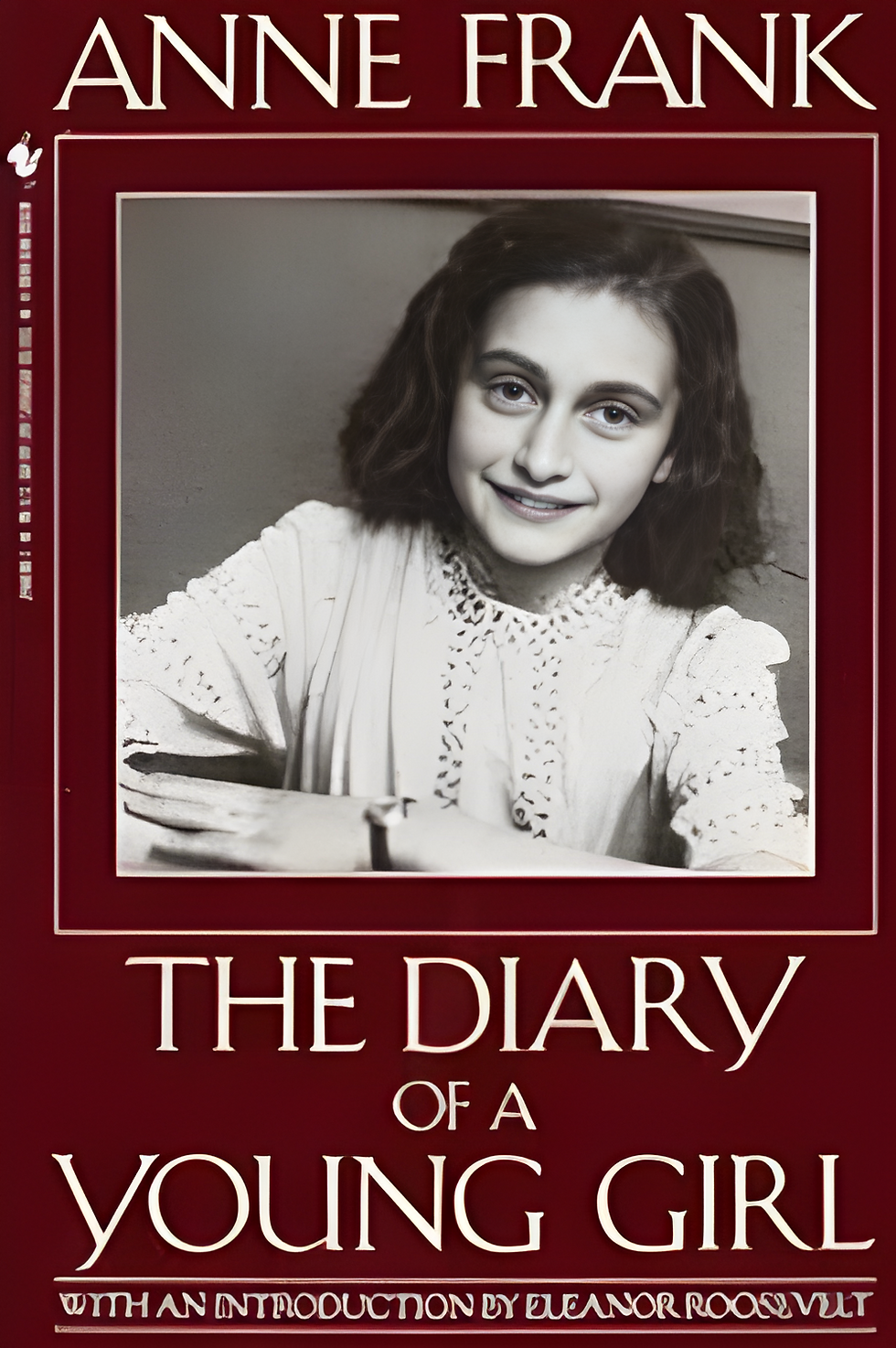
“The Diary of a Young Girl” is one of the few, firsthand account writings we have from Anne Frank, a survivor of the Holocaust War. This book is composed of all of Frank’s diary entry’s as she lived two years of her life, crammed in a “Secret Annexe” of an old office building. While only being part of a small percentage of Jewish people who found protection at this time, her life still consisted of hunger, boredom, fear, and most of all, resilience. For this book to be banned in schools is asking for history to repeat itself. The Holocaust was one of the most horrific wars in our world’s history, and without firsthand accounts to tell us what it truly felt like to live through it, future generations won’t understand the catastrophe it caused.
The subject of history is taught so that students learn how to not repeat our previous mistakes. Frank wrote her entries as a child. Someone these students can connect with easiest. Someone who went through the same body changes they are. Someone who has hormones like they do. Someone who survived childhood when all odds were against her. But we’re banning the book because talk of our anatomy, sexuality, and family life is too inappropriate for young students? These children aren’t any different than she was—anatomically speaking. Where they see puberty, she saw a new threat to getting caught. Nevertheless, this book’s purpose isn’t to teach the young about their bodies; it’s to show them how the actions of others have an impact. How an education in history is so important. How history is never meant to be repeated.
—Sienna Rose Dipaolo, English ‘27
Lord of the Flies, William Golding, 1954

For decades, William Golding’s 1954 novel Lord of the Flies has been a staple of high school reading lists for students around the globe. And why shouldn’t it be? It’s a masterfully written novel about a group of children fighting for their survival long before The Hunger Games or Yellowjackets reignited the idea.
Somewhere along the way it was decided that Lord of the Flies needed to be banned. The reasons for this ban are neither clear nor logical. I’ve seen that it was banned because of violence—even as today’s superhero movies kill off bad guys by the bushel and still dominate the box office. I’ve seen that it was banned for sexual overtones. And with the story centering around a group made up exclusively of boys, we all know that it’s not sexuality that makes certain people think it needs a ban, but it’s homosexuality that they think they’re taking a swing at.
The irony of this is that Lord of the Flies isn’t about either of those things.
It’s a novel about fear and what it does to people—of any age. According to Golding’s book, fear makes us distrustful. Fear makes us violent. Fear makes us dangerous.
In America today, fear also makes us ban books. It makes us ban ideas. Which is just one step away from banning people, a favored pastime of which country has a long and rich history of enjoying.
Lord of the Flies is not the problem. Fear is the problem. Just as any reader of Golding’s work will tell you.
—Jason Mott, Associate Professor, Creative Writing
The Handmaid’s Tale, Margaret Atwood, 1986

It’s a testament to Atwood’s skill as a writer (and perhaps a reflection of our own troubled times), that this 1985 novel still feels modern and increasingly prescient. The Handmaid’s Tale delivers what its title promises: a first-person account from a woman renamed Offred, who is a handmaid in the Republic of Gilead, an authoritarian theocratic country that was once the United States. In Gilead, women are forbidden from reading, and a handmaid’s only value is in getting pregnant so that her commander and his wife can claim her baby as their own. As Offred suffers through the injustices and horrors of Gilead, she consoles herself with memories of her life before—where she had a loving husband and a young daughter, both of whom she has now lost.
Sure, the premise and social commentary alone make this a worthwhile read. And in this post Roe v. Wade United States, such commentary feels especially necessary. But these aren’t the only reasons to read this novel, for its Atwood’s sly, wry way with words that really makes Offred’s story shine. This dystopia is about so much more than the problems of patriarchy and fascist ideology. It offers readers complex ruminations about feminine power, complicity, the nature of storytelling, and the murkiness of time. This is a novel about a future that’s obsessed with the past, and it acts simultaneously as a cautionary tale, a prediction, a warning. Simply put, this novel is brilliant. Everyone should read it.
—Michelle Donahue, Associate Professor, Creative Writing
Watchmen, Alan Moore, Dave Gibbons, and John Higgins, 1986

Watchmen is a limited series, originally published from 1986 until 1987, about an alternate version of America in 1985 where costumed superheroes have been around since the 1930s, directly interacting and altering real-world events. However, when one of these heroes is mysteriously murdered, the vigilante known as Rorschach begins reconnecting with his former team in an attempt to uncover the killer and possibly stop them from killing more superheroes.
Upon its release, Watchmen was controversial for its use of very adult themes and material in a medium that was still seen as predominantly for children. However, it is also recognized as incredibly important in the history of western comics, as it was revolutionary for both deconstructing and satirizing the entire concept of superheroes while also tackling many cold war era political issues. The series is seen by many as the point when comics “grew up." Besides its significance, it’s also an incredibly well told story that beautifully uses the medium in ways only comics can. If you haven’t read Watchmen, I highly recommend it and believe it should be more often recognized for its importance in modern western literature.
—Jackson Whitley, English '28
Beloved, Toni Morrison, 1987

To state it far too simply, Toni Morrison’s 1987 novel Beloved introduces us to a formerly enslaved woman, Sethe, who finds freedom in Ohio, but is plagued both by the memories of Sweet Home, the Kentucky plantation from which she escaped, and the ghost of her baby, whom she murdered to protect the child from being forced into slavery. A haunting ensues.
The book is based on the true story of an enslaved woman, Margaret Garner, who was made infamous in 1856 for killing her infant daughter rather than have the baby returned to bondage after the fugitive slave act required them to return to the Kentucky slave owner from whom Margaret had escaped. When she was caught, Margaret would not be charged with murder; instead she was charged with destruction of property.
It’s no wonder Beloved—and all of Morrison’s work, really—frequently meets the ire of folks who make a hobby of challenging and banning books. Not because of the kind of horrific act Sethe commits which sets Beloved’s narrative into motion, but rather because of how unapologetically Morrison’s work grapples with the darkness that complicates American history. Morrison’s intimate investigation of the horrifying circumstances wrought upon Sethe as she navigates the institution of slavery and the illusion of freedom, makes real and personal the trauma of the time period with prose that is intelligent, shrewd, and relentlessly unsettling. It cracks open and lays bare the truth of a history that many would rather we forget.
I own three copies of Beloved. One, it would seem, for every era of my life. Each time I come to it, I am different—student, woman, mother—and each time I leave it, I am changed. I’m currently awaiting my 4th copy in the mail—the beautiful Book of the Month Club 100th Anniversary edition—and I’m eager to know what me I will be when I turn its final page. When I open it, breaking its spine for the fourth time in forty years, it will be with the knowledge that, as Morrison wrote in one of her many essays on censorship, “[e]fforts to censor, starve, regulate and annihilate us are clear signs that something important has taken place.” I, for one, hope the brave writers among us continue to bring truth to the page with the fearlessness of Toni Morrison and the determination to wield a pen mighty enough to make us free.
—KaToya Fleming, Associate Professor, Creative Writing
Wicked, Gregory Maguire, 1995

While scrolling through PEN America’s Index of School Book Bans database, I came across one of my favorite books. Wicked has been having a moment, culturally, and with good reason. The first movie has become one of the most successful musical adaptations from stage to screen. With that acclaim came renewed interest in the movie’s and musical’s source material—the 1995 novel written by Gregory Maguire.
Wicked follows Elphaba Thropp, the daughter of a religious political leader in Munchkinland. Elphaba—known in her adulthood as The Wicked Witch of the West—is an outcast throughout her adolescence and early adulthood, having been born both green-skinned and with magical powers over which she has little control. Perhaps her greatest sin in the eyes of the state, however, is her strong sense of justice for the walking and talking Animals who become civic scapegoats. What follows is a story of her coming-of-age in an Oz entrenched in governmental corruption and human rights violations. Tapping in to the The Wizard of Oz’s origins as political allegory, the novel might shock fans of the Disneyfied musical and movie. It is a dark political fantasy that comments on propaganda, the rise of fascism, and how corrupt governments both create and punish their own terrorists in order to seize and maintain power.
It is not easily digestible, either. Elphaba is not a perfect heroine. She is not a martyr. She succumbs to jaded violence. Innocent people die because of her actions. There is no happy ending. No tidy answers. At times, this feels almost punishing for the reader. Which makes the book even more important, because—despite its fairytale setting—it is more indicative of real life.
What is literature for if it does not ask these difficult questions to help us understand our current moment?
—Caitlin Rae Taylor, Lecturer, Creative Writing
The Perks of Being a Wallflower, Stephen Chbosky, 1999

I’m a professor in the creative writing department at UNCW. Often on the first day of class, I’ll go around the room, asking students to name one book that changed or elevated the way they view the world. Without fail, at least one will name Stephen Chbosky’s epistolary novel, The Perks of Being a Wallflower. Even closer to home, this novel was my daughter’s favorite for a long time. “It’s just a special book to grow up with,” Hadley told me, when I asked her why she loved it. “More than any book I’ve read, it portrays how awkward and freeing and scary but simple it is to find your community at a young age.”
Any person, at any stage of life, can find something to appreciate in The Perks of Being a Wallflower, which consistently appears in the top ten of ALA’s “Most Frequently Challenged” books, despite how tamely the 1999 novel compares to those on the shelves today, to say nothing of the average TikTok feed. Charlie, the book’s narrator, is a middle-class kid from a suburb of Pittsburgh. He’s lonely, and on the hunt for his own identity. Like most fifteen-year-olds, Charlie feels everything seismically as he struggles to work out the person he’ll become. Perks doesn’t shy away from trauma, loss, shame, or sorrow. But at its core it’s a hopeful book, assuring us – through Charlie’s sweet, philosophical voice – that there’s a life on the other side of adolescence, and freedom to be found in making and keeping the friends who accept and love us for who we are.
—Nina de Gramont, Professor, Creative Writing
Call Me By Your Name, André Aciman, 2007

Call Me By Your Name is a coming-of-age novel written by Italian-American author André Aciman. It is set in Northern Italy, 1983, and follows a student named Elio's sudden, intense romantic relationship. The story is narrated by Elio in a stream-of-consciousness style and explores his thoughts and feelings in an incredibly earnest and raw way. The novel explores themes of obsession, longing, heartbreak, romance, and homosexual relationships, with the events taking place almost entirely over the course of one fateful summer. Banned in both Alaska and Florida in 2023, the novel was subject to controversy due to its homosexual themes and the unfiltered glimpse into the mind of a teen discovering his sexuality. This further emphasizes why this novel is so important. Sexuality, and particularly homosexuality, can be an incredibly difficult thing to manage and understand for a teenager entering adulthood and understanding both themselves and their place in the world. This novel confronts those feelings, doubts and insecurities directly, forcing the reader to imagine themselves as Elio and process those feelings, doubts and insecurities themselves. I found the novel to be incredibly therapeutic, moving and deeply meaningful, and I would recommend Call Me By Your Name to anyone who loves coming-of-age stories, psychological character studies, and those who have ever found themselves loving or longing.
—Aiden McKinney, English '27
The Hunger Games, Suzanne Collins, 2008-2025
English Assistant Professor Chelsea Keane's students read all of the Hunger Games series in her ENG 190 Adventures in Literature class—and they had such a great time that some of them still meet up and chat about the books and films to come.
(L-R top photo: Maggie Beck '28, Mollie Green '28, Assistant Professor Chelsea Keane, Paige Needham '27.)
Suzanne Collins' The Hunger Games (2008), Catching Fire (2009), and Mockingjay (2010) follow teenage protagonist Katniss as she enters a televised, government-run death match called the Hunger Games and foments a rebellion against the dictatorial government of Panem, led by the ruthless and bitter President Snow. The Ballad of Songbirds and Snakes (2020) takes place 64 years earlier, and follows teenaged Coriolanus Snow (future president of Panem) as he innovates the eponymous Hunger Games and radicalizes into the fascist dictator from the original trilogy. Sunrise on the Reaping (2025) takes place 24 years before the original trilogy, and follows Katniss's mentor Haymitch Abernathy as he competes in his own Hunger Games and lays the groundwork for the revolution that will play out decades into the future.
The Hunger Games was on the American Library Association's list of Most Frequently Challenged Books in 2013 and their Most Banned and Challenged Books of the Decade (2010-2019). Frequently cited reasons for these challenges were violence supposedly inappropriate for its intended age group, and "religious viewpoint," which is often a dogwhistle for books that contain diverse races, ethnicities, genders, and sexualities. Indeed, these are the precise elements of the books that the popular film series has dampened in order to maintain their PG-13 rating, significantly decreasing the explicit on-page (or screen) wartime violence against children and casting white actors in roles frequently interpreted as being those of non-white characters. I teach an undergraduate class called "Exploring Panem," which is dedicated to deeply reading and analyzing Collins' books. Collins has stated multiple times that dystopian literature isn't necessarily about predicting our future, but exploring our present. We explore Panem on its own terms, while also reckoning with the fact that those are also our terms, as Panem is explicitly a version of the United States.
—Chelsea Keane, Assistant Professor, English