
ROOM ON THE WALL: Inside the Gallery at DREAMS, where ILM's young and working artists share a wall—and nobody takes a cut

Enter one of the main entrances at DREAMS Center for Arts Education and you land in a room built for showing art: high light, long walls, the kind of space a gallery would fight for. For years it sat mostly empty between student showcases. Until Liz Gage, DREAMS' executive director, decided to see the writing, or rather, the art on the wall.
The idea didn't arrive in a strategic planning meeting. It arrived the way most good ideas do: sideways, from a couple of kids.
Back in March, DREAMS Center for Arts Education hosted a veteran art show. When the show came down, artist Loraine Scalamoni left two pieces behind for a stretch while she was out of town, and DREAMS kept an eye on them. A few Dreamers—what DREAMS calls their students—wandered in.
"They were like, oh my gosh, who's this artist? This art is amazing," recalls Gage."They were so excited—or surprised—that they would get to put their artwork alongside, or at the same place, that Loraine put her work." Someone mentioned that they'd get to hang their own work in that same room soon.
And yet, they couldn’t quite believe it.
That flicker of disbelief is the whole thesis of the Gallery at DREAMS. A Dreamer seeing her drawing hung in the same room, on the same wall, under the same lights as a working professional isn't a nice bonus–it’s the point. Kids don't decide they can be artists in the abstract. They decide when they can stand in front of the evidence.

Who The Walls Are For
DREAMS has been teaching kids since 1997, with a mission it states plainly: to create a culture of confidence for youth and teens through equitable access to arts education, supported by the values of respect, family, and community. That word, equitable, is doing genuine work. DREAMS prioritizes young people in need, including kids living below the poverty line, and everything it offers is free of charge. Not discounted. Not a sliding scale. Free.
The programming is not a token art hour. More than 40 classes a week span dance, theater, music, ceramics, painting, culinary arts, filmmaking, and creative writing. The offerings extend beyond the North Side campus. Hundreds of local youth come through each year. In 2007, a national Coming Up Taller Award recognized the program as one of the country's top out-of-school arts programs.
And critically, the adults in those classrooms aren't hobbyists. They're working artists making a living from the subject they're teaching.
That's the context for a Dreamer stopping in front of Loraine Scalamoni's work and being told she'd get a wall too. For a kid whose family can't absorb the cost of private lessons, whose neighborhood isn't on the gallery circuit, and who has rarely seen evidence that "artist" is an available job, the gap between admiring the work and imagining herself making it can look enormous.
The gallery's job is to shrink the gap. Same room, same lights, same wall.
A Beautiful Room Kept Blank
DREAMS has always had the space. What it didn't have was a reason to keep it full. After several years away from Wilmington's Fourth Friday Gallery Nights, the organization is back on the circuit.
"The walls are blank in this gallery, and it's a beautiful gallery," Gage says. "It's got lots of natural light. It's one of the main entrances to the building. So having it filled with beautiful artwork all year long seems like a perfect no-brainer. Why are we not doing this?"
Historically, Dreamer work would go up for a showcase, hang for a while, and come down — leaving months of empty wall in a room that also doubles as a classroom. Gage saw an obvious loop waiting to be closed: real exhibitions on the walls give teaching artists something to build lessons around, and give Dreamers something to look at while they draw. Instead of blank drywall, they're working underneath somebody's finished, framed, for-sale best effort.
There was a second, less sentimental reason, too. Gage came up in the Triangle gallery scene, where one conversation never stopped: there is never enough wall space.
"So it just seems like — well, why don't we open up the doors and invite North Carolina artists to put up solo exhibitions month by month, and just be another opportunity to support local artists."
Zero Commission, On Purpose
The Gallery at DREAMS takes no commission. One hundred percent of every sale goes to the artist — whether that artist is a working professional or an eleven-year-old Dreamer.
"That's really important to me," Gage says. "We need to be supporting our local artists more and more. Art and culture is what makes a city interesting."
The reasoning is driven by a question Gage keeps coming back to: who actually gets to own art?
"When you think about how affordable art is, who can afford art, who can buy art," she says, "there is a lot of stigma or stereotype built up around galleries, around original artwork, and it feels inaccessible."
For a lot of people, walking into a gallery still carries the assumption that the work inside isn't for them — and a price point can quietly confirm it. Taking the commission out of the equation lets DREAMS price work closer to what a neighbor can actually spend, while the artist takes home the full amount. More art in more Wilmington homes, more money in more Wilmington artists' pockets.
Gage is quick to say this isn't a knock on commercial galleries, which carry rent, staff, insurance, and marketing on those percentages — real costs that make the model necessary. "I understand why it is the way it is," she says. “DREAMS is simply in a different position. As a nonprofit with a building the city helps make possible, it has room to try something a commercial space can't, and it would rather use that room than let it sit.”
Her invitation targets her own sector first: "I would challenge more people — especially nonprofits — to get creative about where they supplement their own income."
She's been chasing the idea for a while. At a gallery she ran in Durham, Gage came close to landing a grant that would have covered the gap and let her drop commissions entirely — a workaround she still thinks is worth someone funding.
That's the door she's trying to hold open. Not a critique of how galleries operate, but a live experiment other organizations, funders, and collectors are welcome to watch, borrow from, or improve on. And it's happening in a room full of kids who are paying attention to how the adults handle it.
A Pipeline, Not a Pat on the Head
The gallery isn't a standalone gesture. It's one visible node in something DREAMS has quietly been doing for years.
The organization employs about 42 part-time teaching artists, pushing roughly a quarter of a million dollars into Wilmington's creative economy annually. Most of those teaching artists are working artists who teach at DREAMS to supplement their income so they can keep making their own work. Some of them are former Dreamers, which means some kids in these classrooms are being taught by the person they'll turn out to be. That's mentorship, but it's also proof of concept: a grown-up from around here, making a living, standing at the front of the room.
"We want that cycle to be really present in everything that we do," Gage says. "How are we supporting an artist from infancy — before they've even picked up a paintbrush — through middle school, through high school, and then afterwards, how do we support that art practice?"
The gallery extends that line in both directions, and it hands Dreamers more than a wall.
This fall, a new class led by curator Holly Tripman Fitzgerald — formerly of the Cameron Art Museum, now curating with Project 8179 at 210 Princess St. — will walk students through the parts of the art world nobody usually shows a kid: how to select work, how to build a show around it, how to hang it so it reads. They'll study the DREAMS gallery and the Princess Street gallery side by side, comparing the choices each one made.
Gage notes, “Learning to look hard at art, is its own discipline.” It belongs to these kids as much as making it does. A Dreamer who has argued about which piece goes where has stopped being an audience for the art world and started being a participant in it.
Down the road: adult and all-ages classes. "I hope you'll see a lot more from DREAMS in the next couple of years of all ages really being able to express themselves through art in the space."
Photos taken by Matt Hughes from McKayla Walker's "Can we go home now?" show
Belonging, Hung at Eye Level
Ask Gage why the mix of artists matters—why it isn't enough to just hang good work—and she goes straight to placemaking.
"If you see a reflection of something you relate to in the space, you feel you belong in the space," she says. "Having lots of different artwork and representing a lot of different mediums is only going to help DREAMS feel more like a home, or a second home. Just a safe space for everyone."
Which is why the range of who hangs there matters as much as the quality. A Dreamer who walks past a photographer one month, a cartoonist the next, and a weaver the month after that is being handed a wider answer to the question of what an artist looks like—and a better chance of finding herself somewhere in it.
That instinct runs through the rest of the year's plans. Not every kid can get to the North Side campus, so DREAMS goes to them, with outreach sites at MLK, Maides Park, and Creekwood, plus programming at GLOW. Leland is next on the list, along with more schools and community centers. The goal is the same in every one of those rooms: put art within walking distance of the kid who needs it.
The Call is Open
Here's the part Gage most wants Wilmington to hear: the calendar isn't full, and that's by design.
The Gallery at DREAMS is actively seeking North Carolina artists for month-long solo and group exhibitions, and the call is genuinely open — young artists just finding a voice, emerging artists learning to navigate the professional side, teaching artists, and established artists looking for a meaningful place to show. Painters, photographers, ceramicists, fiber artists, printmakers, illustrators. Gage would rather field too many applications than too few.
The application is a short form; artists can request it by emailing programs@dreamswilmington.org. It also goes out through the DREAMS newsletter, and will land on the website soon.
One detail worth knowing before you apply: as the applicant pool grows, Dreamers will help jury the shows. The kids will be reading artist statements, weighing bodies of work, and making the call. For an applicant, that means your submission isn't just a bid for wall space — it's teaching material, and a room full of young people will be studying how you present yourself as a professional.
And the terms don't change with your resume. Zero commission, whoever you are.
Curating a Community
Filling the walls is only the most visible version of what DREAMS is trying to do. The same instinct — invite people in, give them a real role, don't take a cut — runs through everything else on the calendar.
Volunteer. DREAMS recently hired a development and community engagement manager whose central charge is building the volunteer program, starting with an initiative to place one volunteer in every classroom this fall and spring. But classrooms are just the start: the garden needs hands, the building needs hands, events need hands. "Just reach out and tell us what you want to do," Gage says, "and we will help make that happen."
Get the kids there. Transportation remains the organization's most stubborn barrier. A volunteer bus driver named Laurence Roth now runs the bus four days a week — "He's absolutely amazing," Gage says — and it still isn't enough. Anyone who can help close that gap, or host programming in a neighborhood DREAMS hasn't reached yet, is worth a conversation.
Bring your event, or come to theirs. DREAMS hosts free monthly family movie nights,is planning a harvest hangout with the co-op, and it's opening the building to other organizations' events. "The city has been so good to us to allow us to have this building," Gage says, "but I think we can be a better steward of that space, and a better community connector."
Buy the work. Every dollar goes to the artist. There is no more direct way to support a Wilmington maker.
Show up. The annual fundraiser is October 23, with jazz from Benny Hill, DJ sets from Infinite Spins, and food from Rude Bwoys Jerk BBQ ; tickets are on sale now. Or come on Fourth Friday, walk the gallery, and meet whoever's hanging that month.
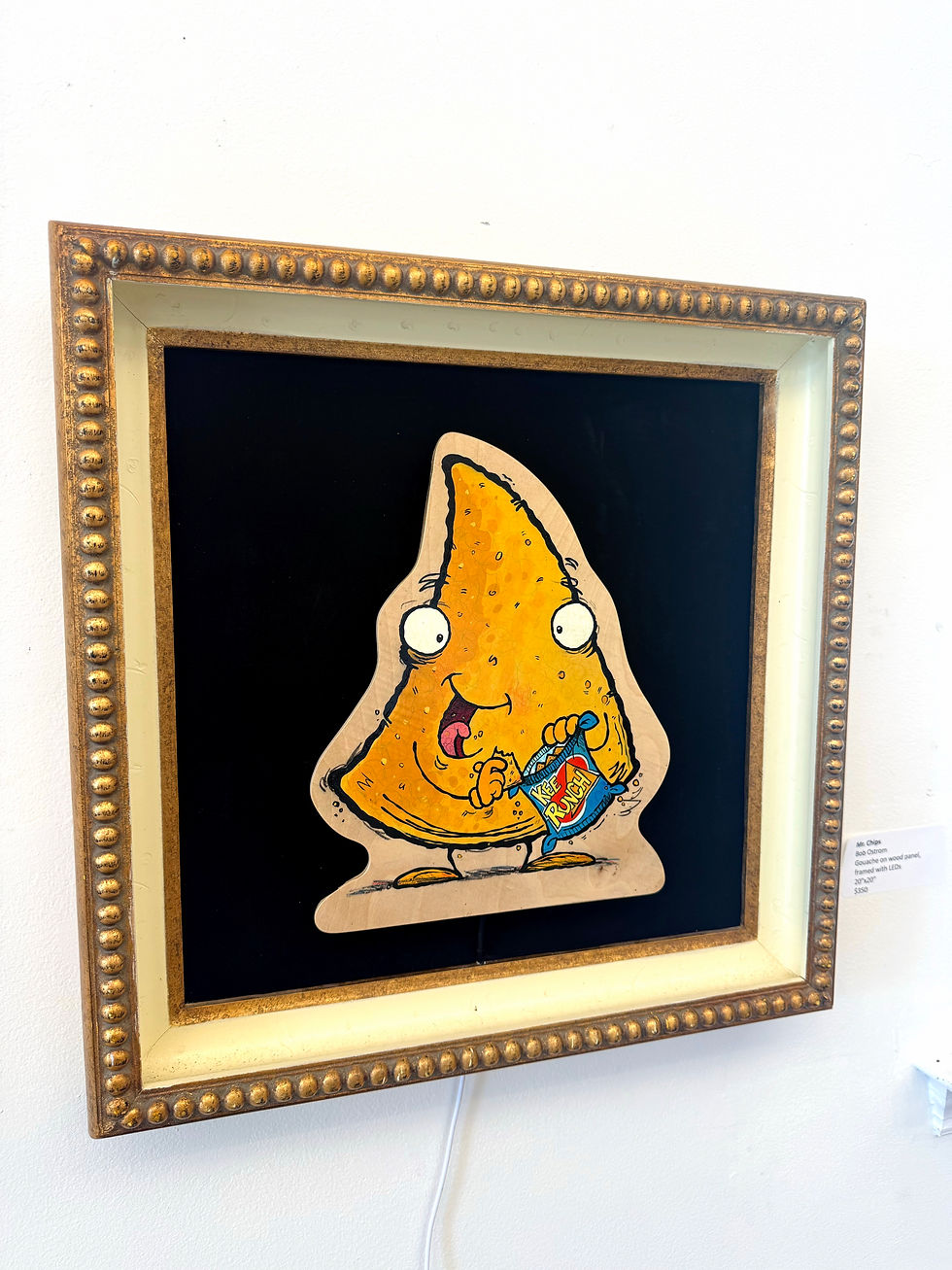
On view now is Wooden That Be Fun?, Bob Ostrom's collection of larger-than-life mermaids and whimsical sea creatures painted in acrylic gouache on plywood. The Cary-based artist and illustrator — whose work has appeared in more than 250 children's books, plus toy packaging, logos, and pro sports mascots — describes his style as "Pop-Art, Cartoontistic-Illustrationism." It's the gallery's second show, following McKayla Walker's July exhibition. September brings "On the Horizon," large-scale handwoven pieces by fiber artist Courtney LaCaria, who raises the alpacas whose fleece ends up in her weavings.
A gallery, it turns out, is a lot like a community. Somebody has to decide what belongs, make room for it, and light it well. DREAMS is betting that if you do that with enough care — and let the kids help — you end up curating more than a wall.
"Support local artists. Support DREAMS," Gage says. "No matter what age you are."
The Gallery at DREAMS is located at 901 Fanning Street on Wilmington's North Side. Since 1997, DREAMS Center for Arts Education has provided free-of-charge arts education to youth and teens ages 8 to 17 across Wilmington and New Hanover County, with programming at its 12,000-square-foot North Side campus and at sites throughout the community. Artists interested in exhibiting can contact programs@dreamswilmington.org. Learn more at givetodreams.org.


